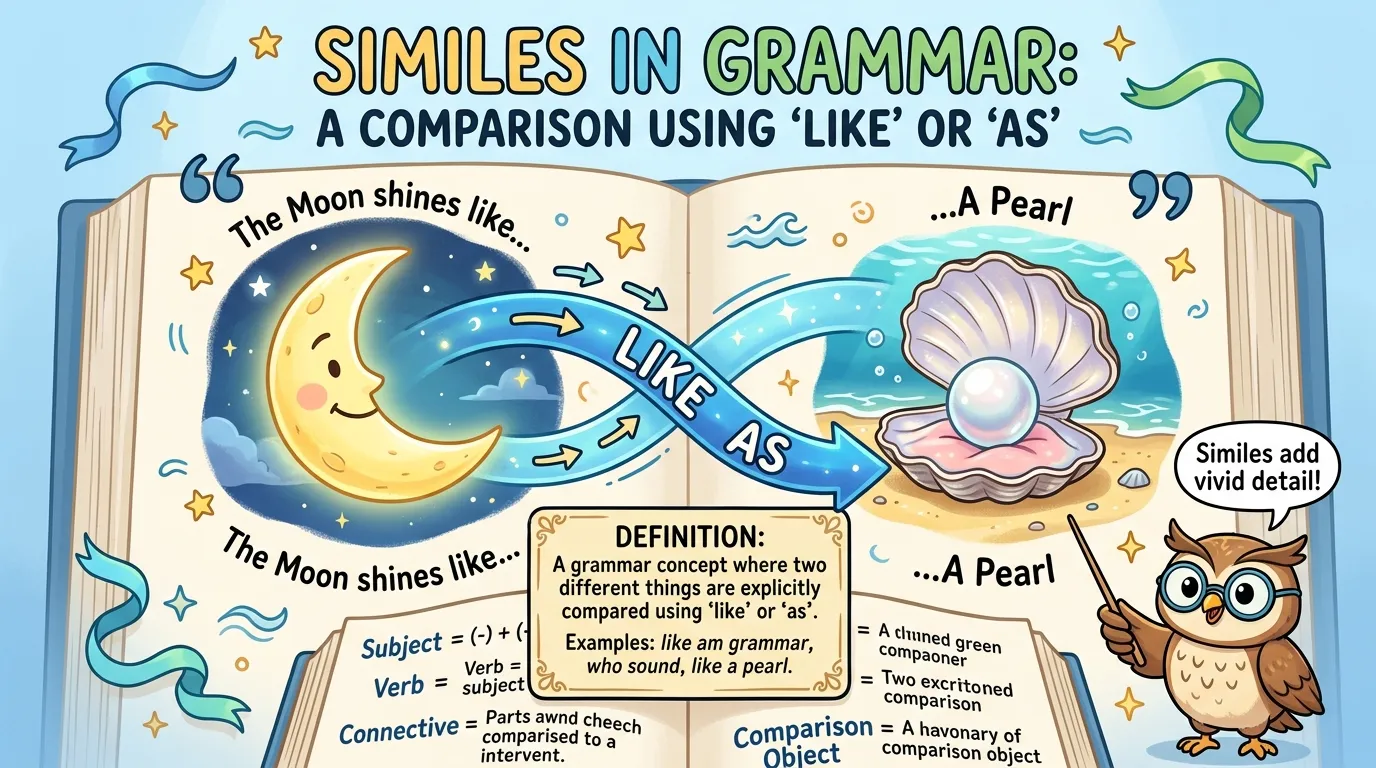
Similes in grammar are an important part of figurative language and descriptive English. They allow writers and speakers to compare two unlike things in a way that makes an idea easier to imagine, understand, or remember. Most familiar English similes use “like” or “as” to create an explicit comparison.
A simple sentence such as “The girl was nervous” tells us a fact, but it does not give us much of a picture. If we say, “The girl was as nervous as a bird in a cage,” the reader gets a much stronger sense of her feelings. This is one of the main reasons writers use similes: they turn ordinary descriptions into language that readers can visualize.
Although similes are often taught in English classes as a literary device, they are also useful in everyday communication. People use familiar comparisons to describe personalities, emotions, weather, speed, appearance, sounds, experiences, and situations. Similes appear in poetry, fiction, speeches, advertising, conversations, and other forms of communication.
Learning how similes work can therefore help students improve both their grammar awareness and writing style. It can also make it easier to identify figurative language when reading. Once you understand the basic structure, you can recognize common similes and create original ones with confidence.
In this complete guide, we will explore 67 examples of similes in grammar, their structures, common patterns, meanings, differences from metaphors, common mistakes, and practical ways to use them effectively in writing.
What Is a Simile in Grammar?
A simile is a figure of speech that explicitly compares two unlike things, usually with words such as “like” or “as.”
For example:
He is as strong as an ox.
This sentence does not mean that the person is literally an ox. It compares his strength with the strength commonly associated with an ox.
Another example is:
She sings like a bird.
The person is not literally a bird. The comparison suggests that she sings beautifully or naturally.
The important idea is that a simile creates a figurative comparison rather than simply stating that two things are identical.
Why Are Similes Important in English Grammar?
Similes are useful because they make language more descriptive, expressive, and memorable.
Instead of simply saying:
The water was calm.
A writer might say:
The water was as smooth as glass.
The second sentence gives the reader a clearer mental picture.
Similes can help writers:
- Create vivid imagery
- Describe emotions
- Explain unfamiliar ideas
- Make stories more interesting
- Improve descriptive writing
- Add personality to sentences
- Make speeches more memorable
- Strengthen creative expression
The Academy of American Poets notes that similes are particularly useful for creating imagery and helping readers visualize how a person, object, or action might appear.
Basic Simile Structure
There are two very common patterns for creating similes in English.
The “As…As” Pattern
The basic structure is:
Subject + verb + as + adjective + as + noun
For example:
She is as quiet as a mouse.
Here:
- She = subject
- is = verb
- quiet = adjective
- mouse = comparison
Another example:
The snow was as white as cotton.
The adjective white describes the quality being compared.
The “Like” Pattern
Another common structure is:
Subject + verb + like + noun
Examples:
He runs like the wind.
She sings like a bird.
The stars shine like diamonds.
In each sentence, like introduces the comparison.
67 Similes in Grammar With Examples
Similes for Strength
1. As strong as an ox
Meaning: Very strong.
2. As strong as steel
Meaning: Extremely strong or determined.
3. He fought like a lion.
Meaning: He fought with great courage and strength.
4. Her determination was like iron.
Meaning: Her determination was extremely firm.
5. He stood as strong as an oak tree.
Meaning: He remained strong and steady.
Similes for Speed
6. As fast as lightning
Meaning: Extremely fast.
7. As quick as a cheetah
Meaning: Very quick.
8. He runs like the wind.
Meaning: He runs very quickly.
9. The car moved like a rocket.
Meaning: The car moved extremely fast.
10. She moved as quickly as an arrow.
Meaning: She moved very rapidly.
Similes for Quietness
11. As quiet as a mouse
Meaning: Extremely quiet.
12. As silent as the night
Meaning: Very quiet.
13. The room was as quiet as a library.
Meaning: The room was extremely quiet.
14. He moved like a shadow.
Meaning: He moved quietly and almost unnoticed.
15. The forest was as silent as falling snow.
Meaning: The forest was exceptionally quiet.
Similes for Brightness
16. As bright as the sun
Meaning: Extremely bright.
17. As bright as a star
Meaning: Very bright or radiant.
18. Her eyes sparkled like diamonds.
Meaning: Her eyes looked bright and beautiful.
19. The city glittered like a field of stars.
Meaning: The city appeared full of bright lights.
20. His smile shone like sunshine.
Meaning: His smile appeared warm and cheerful.
Similes for Softness
21. As soft as silk
Meaning: Very soft and smooth.
22. As soft as a cloud
Meaning: Extremely soft.
23. The blanket felt like velvet.
Meaning: The blanket felt very smooth and soft.
24. Her voice was as gentle as a breeze.
Meaning: Her voice was soft and calming.
25. The kitten was as soft as cotton.
Meaning: The kitten felt extremely soft.
Similes for Temperature
26. As cold as ice
Meaning: Extremely cold.
27. As cold as winter snow
Meaning: Very cold.
28. His hands were as cold as stone.
Meaning: His hands were extremely cold.
29. The soup was as hot as fire.
Meaning: The soup was extremely hot.
30. The afternoon felt like a furnace.
Meaning: The weather felt extremely hot.
Similes for Happiness
31. As happy as a lark
Meaning: Extremely happy.
32. As cheerful as a rainbow
Meaning: Very cheerful and positive.
33. She smiled like sunshine after rain.
Meaning: Her smile expressed warmth and happiness.
34. He was as happy as a child on vacation.
Meaning: He was extremely happy.
35. Her laughter was like music.
Meaning: Her laughter was pleasant and joyful.
Similes for Sadness
36. Her heart felt as heavy as a stone.
Meaning: She felt deeply sad.
37. His sadness hung over him like a dark cloud.
Meaning: His sadness strongly affected him.
38. Her tears fell like rain.
Meaning: She was crying heavily.
39. He felt as lonely as a single star.
Meaning: He felt extremely alone.
40. The memory returned like a sad song.
Meaning: The memory brought back painful emotions.
Similes for Anger
41. His anger burned like fire.
Meaning: His anger was intense.
42. She was as angry as a raging storm.
Meaning: She was extremely angry.
43. Anger spread through him like wildfire.
Meaning: His anger grew rapidly.
44. His words struck like thunder.
Meaning: His words were powerful and shocking.
45. Her temper exploded like a volcano.
Meaning: She suddenly became extremely angry.
Similes for Intelligence
46. As wise as an owl
Meaning: Very wise.
47. As sharp as a razor
Meaning: Very intelligent or observant.
48. His mind worked like a computer.
Meaning: He could process information quickly.
49. She was as clever as a fox.
Meaning: She was very clever.
50. His ideas flowed like a river.
Meaning: He produced ideas easily and continuously.
Similes for Beauty
51. As beautiful as a rose
Meaning: Very beautiful.
52. As graceful as a swan
Meaning: Very elegant.
53. Her eyes were like shining stars.
Meaning: Her eyes looked beautiful and bright.
54. The garden looked like a painting.
Meaning: The garden was exceptionally beautiful.
55. Her smile was like a summer sunrise.
Meaning: Her smile was warm, bright, and beautiful.
Similes for Everyday Situations
56. As busy as a bee
Meaning: Extremely busy.
57. As hungry as a wolf
Meaning: Extremely hungry.
58. As proud as a peacock
Meaning: Very proud.
59. As stubborn as a mule
Meaning: Unwilling to change one’s mind.
60. As clear as glass
Meaning: Very clear or easy to understand.
61. The classroom was as busy as a beehive.
Meaning: Everyone was active and working.
62. The baby slept like a log.
Meaning: The baby slept very deeply.
63. The moon looked like a silver coin.
Meaning: The moon looked round and shiny.
64. The clouds floated like ships.
Meaning: The clouds appeared to move slowly across the sky.
65. The rain fell like silver threads.
Meaning: The rain looked thin and continuous.
66. Time passed like water through my fingers.
Meaning: Time seemed to pass quickly and could not be held onto.
67. Hope shone like a candle in the darkness.
Meaning: Hope provided comfort during a difficult situation.
Similes in Different Parts of a Sentence
A simile can appear in different grammatical positions depending on the sentence.
Simile as a Description After a Verb
The child was as quiet as a mouse.
The simile describes the child.
Simile After an Action Verb
The horse ran like the wind.
The simile describes how the horse ran.
Simile Within a Longer Sentence
As the storm approached, the trees shook like frightened animals.
The comparison adds imagery to the sentence.
Simile at the Beginning of a Sentence
Like a bird released from a cage, she ran toward the open field.
Placing a simile at the beginning can create a dramatic effect.
Not Every “Like” or “As” Is a Simile
This is an important point when studying similes in grammar.
Simply seeing “like” or “as” does not automatically mean a sentence contains a simile. The comparison must generally be figurative rather than simply literal.
Literal Comparison
She looks like her mother.
This can be a literal statement about physical resemblance.
Figurative Simile
She shines like the sun.
She is not literally the sun. The comparison is figurative.
Another Example
I am as tall as my brother.
This is normally a literal comparison.
But:
I am as tall as a mountain.
This is a figurative comparison and can function as a simile.
Simile vs. Metaphor
Similes and metaphors are closely related, but their structures are different.
Simile
A simile makes the comparison explicit, commonly using “like” or “as.”
Her smile is like sunshine.
Metaphor
A metaphor makes a direct comparison:
Her smile is sunshine.
The first sentence clearly signals a comparison. The second presents the comparison directly.
Quick Difference
| Simile | Metaphor |
|---|---|
| Uses “like” or “as” | Usually makes a direct comparison |
| Explicit comparison | More direct comparison |
| “He is as brave as a lion.” | “He is a lion.” |
| “Her voice is like music.” | “Her voice is music.” |
Simile vs. Analogy
A simile and an analogy can both compare different things, but they usually have different purposes.
A simile is often used to describe something:
The child’s mind was like a sponge.
An analogy often goes further by using a comparison to explain an idea or relationship.
For example:
Learning a language is like building a house because both require a strong foundation and steady practice.
Similes focus heavily on imagery and description, while analogies can be used to explain concepts or make reasoning easier.
Why Writers Use Similes
Similes are powerful because they help readers see rather than simply be told.
Compare:
The man was nervous.
with:
The man’s hands shook like leaves in a storm.
The second sentence gives the reader a physical image of nervousness.
Similes can:
Create Imagery
The clouds were like mountains floating across the sky.
Express Emotion
Her sadness was as heavy as a stone.
Describe Characters
He was as stubborn as a mule.
Establish Mood
The hallway was as dark as a moonless night.
Make Writing Memorable
His ideas flowed like a river.
How to Create Your Own Similes
Creating a good simile is easier when you follow a few simple steps.
Step 1: Choose What You Want to Describe
For example:
A very nervous person
Step 2: Identify the Main Quality
The person is:
- Worried
- Restless
- Shaky
- Afraid
Step 3: Think of Something With a Similar Quality
A bird trapped in a cage can represent nervousness and restlessness.
Step 4: Add “Like” or “As”
She was as nervous as a bird in a cage.
Step 5: Make It More Specific
Instead of stopping there, connect the comparison to your setting:
Her thoughts fluttered like a sparrow trapped beneath the roof of an empty station.
This creates a more personal and vivid image.
Common Mistakes When Using Similes
Using “Like” Without a Figurative Comparison
Not every use of “like” creates a simile.
He looks like his father.
This may be literal.
Using “As” Incorrectly
A common beginner mistake is:
He is as strong like an ox.
A standard as…as simile would be:
He is as strong as an ox.
Making the Comparison Confusing
A simile should help readers understand something, not make the sentence harder to interpret.
Using Too Many Similes
One strong comparison can be more effective than several weak ones.
Using Unrelated Images
Make sure the comparison communicates a meaningful quality.
How to Teach Similes in Grammar
Teachers can make similes easier by starting with familiar examples.
Activity 1: Complete the Simile
Give students:
- As cold as ______.
- As bright as ______.
- As soft as ______.
- As fast as ______.
- As quiet as ______.
Students create their own endings.
Activity 2: Find the Comparison
Give students a sentence such as:
The runner moved like lightning.
Ask:
- What is being described?
- What is it compared to?
- Which word introduces the comparison?
- What quality do they share?
Activity 3: Simile or Not?
Ask students to decide whether each sentence contains a simile.
She runs like the wind.
She looks like her sister.
He is as strong as an ox.
The book is as heavy as the dictionary.
This teaches students that context matters.
Tips for Using Similes Effectively
To make your similes stronger:
- Choose comparisons that are easy to visualize.
- Use specific images.
- Think about the five senses.
- Match the comparison to your subject.
- Consider your audience.
- Avoid unnecessary clichés.
- Keep the sentence natural.
- Use similes when they genuinely add meaning.
Similes are especially effective in creative writing, poetry, storytelling, speeches, advertising, and everyday language, although writers should consider the context before using figurative language in highly formal writing.
Frequently Asked Questions
What is a simile in grammar?
A simile is a figurative comparison between two unlike things, commonly introduced by “like” or “as.”
What are the main words used in similes?
The most familiar words are “like” and “as.” Some definitions also recognize other explicit comparison forms, such as “than” in certain constructions.
What is the easiest simile to learn?
A simple example is:
As busy as a bee.
It is short, familiar, and easy to understand.
Is a simile a grammatical rule?
Not exactly. A simile is primarily a figure of speech, but it uses grammatical structures to create comparisons.
Are all “as…as” sentences similes?
No. Some as…as constructions are literal.
She is as tall as her sister.
This is a literal comparison.
She is as tall as a mountain.
This is figurative.
Can similes be used in academic writing?
They can be used when appropriate, but academic writing often favors precise and literal language. The suitability of a simile depends on the subject, purpose, and expectations of the writing.
Conclusion
Understanding similes in grammar is an important step toward becoming a stronger reader, writer, and English learner. A simile does much more than add decorative language to a sentence. It creates a bridge between two ideas, allowing readers to understand an emotion, action, object, or experience through something familiar.
The most recognizable similes use “like” or “as” to make an explicit comparison. For example, saying “the water was as smooth as glass” immediately gives the reader an image of calmness and smoothness. Similarly, “she ran like the wind” communicates speed more vividly than simply saying that she ran quickly. Definitions from major English-language references consistently describe similes as comparisons between unlike things, commonly using “like” or “as.”
For students, learning similes can strengthen figurative-language skills, vocabulary, reading comprehension, and descriptive writing. For writers, similes can add atmosphere, emotion, characterization, and imagery. For English learners, they can also provide useful examples of how ordinary words can be combined to communicate ideas in a more expressive way.
The key is to remember that not every sentence containing “like” or “as” is automatically a simile. The comparison generally needs to be figurative and meaningful. Once you learn to identify the two things being compared and the quality they share, recognizing similes becomes much easier.
The best similes are also purposeful. They should help the reader see, feel, hear, or understand something more clearly. Instead of adding comparisons simply to make writing sound fancy, choose images that naturally support your message. A carefully selected simile can turn a plain sentence into a vivid description that stays with the reader.
With the 67 examples, structures, rules, and writing tips in this guide, you now have a strong foundation for understanding and using similes. Keep practicing with different subjects such as people, emotions, animals, nature, weather, school, work, relationships, and everyday experiences. The more you experiment with comparisons, the easier it will become to create original similes that make your English more expressive, engaging, and memorable.

James Williams is a dedicated language writer and contributor at Mitaphor.com, where he explores the art of similes, metaphors, and word meanings. With a passion for making language simple and engaging, James breaks down complex expressions into clear, easy-to-understand insights. His work is designed to help students, writers, and curious readers better understand figurative language and use it effectively in everyday communication.