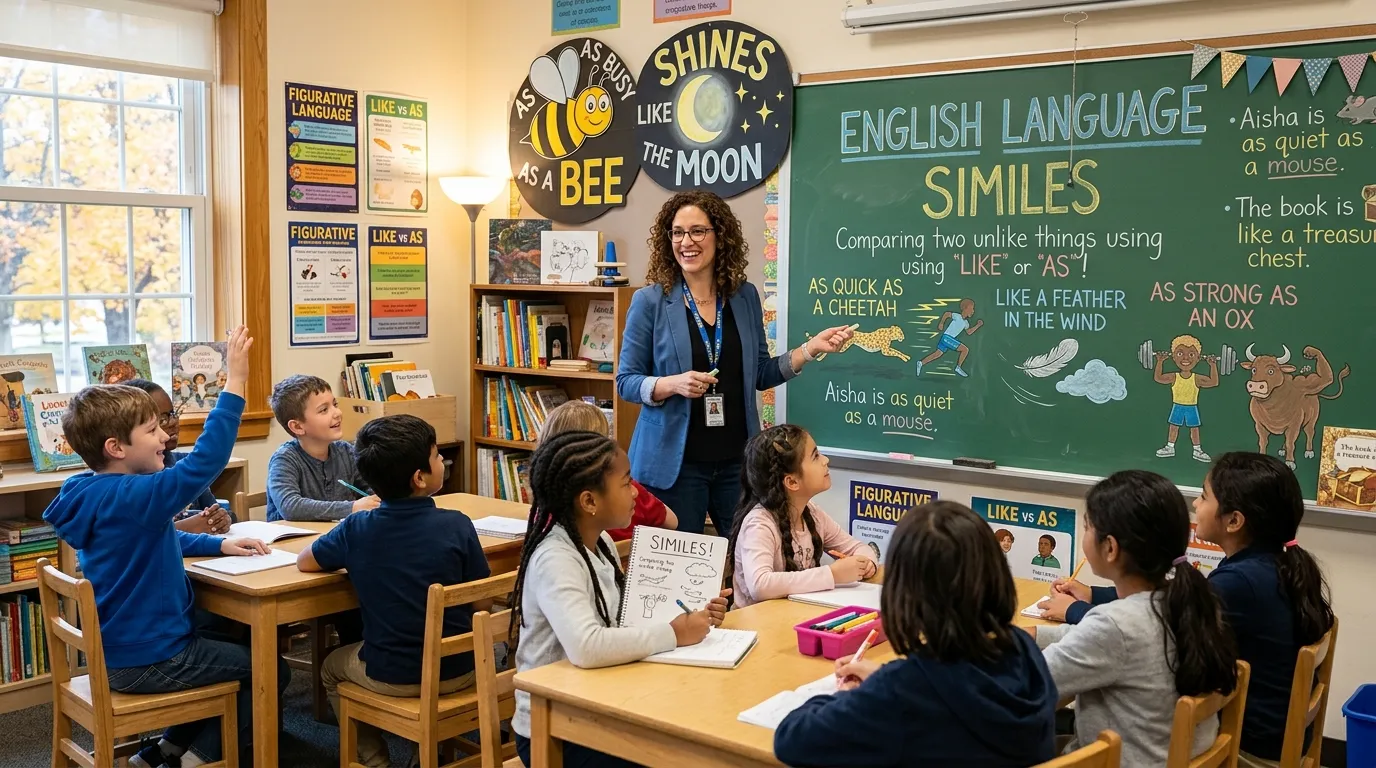
Similes in the English language are among the most widely used figures of speech. They help speakers and writers compare two unlike things in a way that creates vivid imagery, strengthens communication, and makes ideas easier to understand. Whether found in everyday conversations, literature, poetry, songs, speeches, advertising, or academic discussions, similes play an important role in making language more expressive and memorable.
Imagine reading a story that says, “The night was dark.” The sentence communicates information, but it doesn’t create a particularly strong image. Now consider the sentence, “The night was as dark as a cave.” The comparison immediately helps readers picture the darkness more clearly. This ability to transform ordinary descriptions into vivid mental images is one of the reasons similes have remained a powerful part of the English language for centuries.
Students encounter similes early in their education because they provide an accessible introduction to figurative language. Writers rely on them to create atmosphere, describe characters, express emotions, and paint detailed scenes. Speakers use them to explain ideas, persuade audiences, and make conversations more engaging. Even in everyday communication, people frequently use common similes such as “as busy as a bee” or “as cool as a cucumber” without giving much thought to their figurative nature.
Learning about similes can improve reading comprehension, expand vocabulary, strengthen writing skills, and develop a deeper appreciation for how language works. Once you understand the basic patterns and purposes of similes, you’ll begin noticing them everywhere—from novels and movies to advertisements and social media posts.
In this comprehensive guide, you’ll learn what similes are, how they function in the English language, the different types of similes, common grammatical structures, practical examples, writing tips, common mistakes, and 73 simile examples that demonstrate how comparisons can bring language to life.
What Are Similes in English Language?
A simile is a figure of speech that compares two different things using words such as “like” or “as.”
The purpose of a simile is to help readers or listeners understand one thing by comparing it to something familiar.
Example:
He is as brave as a lion.
The person is not literally a lion. The simile compares the person’s bravery to the courage commonly associated with lions.
Another example:
She sings like a bird.
The person is not a bird. The comparison suggests that she sings beautifully.
In simple terms, similes make descriptions more vivid, imaginative, and meaningful.
Why Are Similes Important in English?
Similes serve several important purposes in communication.
They Create Mental Images
A simile helps readers visualize what is being described.
Instead of:
The lake was calm.
A writer might say:
The lake was as smooth as glass.
The second sentence creates a clearer image.
They Improve Writing
Similes make essays, stories, poems, and articles more engaging and descriptive.
They Express Emotions
Feelings can be difficult to describe directly. Similes help communicate emotions more effectively.
Example:
Her sadness was as heavy as a stone.
They Simplify Complex Ideas
Comparisons can make unfamiliar concepts easier to understand.
They Make Language Memorable
People tend to remember vivid comparisons more easily than plain statements.
Basic Structure of Similes
Most English similes follow one of two common patterns.
Pattern 1: As…As
Subject + verb + as + adjective + as + noun
Examples:
- As brave as a lion
- As cold as ice
- As soft as silk
- As bright as the sun
- As quiet as a mouse
Pattern 2: Like
Subject + verb + like + noun
Examples:
- Runs like the wind
- Sings like a bird
- Sleeps like a log
- Shines like a star
- Moves like a shadow
Types of Similes in English Language
1. Descriptive Similes
These describe appearance, qualities, or characteristics.
Example:
As white as snow.
2. Emotional Similes
These describe feelings and emotions.
Example:
Her anger burned like fire.
3. Nature-Based Similes
These use natural objects or phenomena.
Example:
The clouds floated like ships.
4. Animal Similes
These compare people or things to animals.
Example:
As wise as an owl.
5. Action Similes
These describe movement or behavior.
Example:
He ran like the wind.
6. Sound Similes
These describe sounds.
Example:
The thunder roared like a giant drum.
73 Simile Examples in English Language
Similes About Strength
- As strong as an ox.
- As strong as steel.
- He fought like a lion.
- Her will was as firm as iron.
- He stood like an ancient oak.
Similes About Speed
- As fast as lightning.
- As quick as a cheetah.
- He ran like the wind.
- The car moved like a rocket.
- She raced like an arrow.
Similes About Quietness
- As quiet as a mouse.
- As silent as the night.
- The room was as quiet as a library.
- He moved like a shadow.
- The forest was as silent as falling snow.
Similes About Brightness
- As bright as the sun.
- As bright as a star.
- Her eyes sparkled like diamonds.
- The city glittered like stars.
- His smile shone like sunshine.
Similes About Softness
- As soft as silk.
- As soft as a cloud.
- The blanket felt like velvet.
- Her voice was as gentle as a breeze.
- The kitten was as soft as cotton.
Similes About Cold and Heat
- As cold as ice.
- As cold as snow.
- His hands were as cold as stone.
- The soup was as hot as fire.
- The desert felt like an oven.
Similes About Happiness
- As happy as a lark.
- As cheerful as a rainbow.
- Her smile was like sunshine.
- He was as happy as a child on vacation.
- Her laughter sounded like music.
Similes About Sadness
- Her heart felt as heavy as a stone.
- His sadness hung like a cloud.
- Tears fell like rain.
- He felt as lonely as a single star.
- The memory returned like a sad song.
Similes About Anger
- His anger burned like fire.
- She was as angry as a storm.
- Anger spread like wildfire.
- His words struck like thunder.
- Her temper exploded like a volcano.
Similes About Intelligence
- As wise as an owl.
- As sharp as a razor.
- His mind worked like a computer.
- She was as clever as a fox.
- Ideas flowed like a river.
Similes About Beauty
- As beautiful as a rose.
- As graceful as a swan.
- Her eyes were like stars.
- The garden looked like a painting.
- Her smile was like a sunrise.
Everyday Similes
- As busy as a bee.
- As hungry as a wolf.
- As proud as a peacock.
- As stubborn as a mule.
- As clear as glass.
- The baby slept like a log.
- The moon looked like a silver coin.
- The clouds floated like ships.
- The rain fell like silver threads.
- Time passed like water through fingers.
- Hope shone like a candle in darkness.
- The classroom was as busy as a beehive.
- The road was as straight as an arrow.
- The lake was as smooth as glass.
- The stars glittered like jewels.
- She danced like a butterfly.
- He ate like a horse.
- The leaves danced like tiny birds in the wind.
Similes in Literature and Poetry
Writers often use similes to create strong imagery and emotional impact.
Example:
The waves crashed like thunder against the shore.
This comparison helps readers hear and visualize the scene.
Poets frequently use similes because they can communicate emotions and images quickly while adding beauty to language.
Similes in Everyday English
Many similes have become common expressions in daily speech.
Examples include:
- As cool as a cucumber.
- As easy as pie.
- As blind as a bat.
- As free as a bird.
- As busy as a bee.
- As light as a feather.
- As clear as day.
Using these expressions naturally can make conversations sound more fluent and engaging.
Simile vs. Metaphor
Many learners confuse similes and metaphors.
Simile
Uses “like” or “as.”
Her smile is like sunshine.
Metaphor
Makes a direct comparison.
Her smile is sunshine.
Both compare two unlike things, but similes explicitly signal the comparison.
Common Mistakes When Using Similes
Using Too Many Similes
Too many comparisons can make writing feel crowded.
Choosing Weak Comparisons
The two things should share a clear quality.
Mixing Images
Avoid combining unrelated comparisons in the same sentence.
Using Clichés Excessively
Common similes are useful, but original comparisons often create a stronger impact.
Forgetting the Shared Quality
A simile should help readers understand something specific.
How to Create Original Similes
Step 1: Choose a Subject
Example: A nervous student.
Step 2: Identify the Main Quality
Nervousness.
Step 3: Think of Something Similar
A bird trapped in a cage.
Step 4: Build the Comparison
The student was as nervous as a bird in a cage.
Step 5: Add Details
The student was as nervous as a sparrow trapped inside a crowded room.
Specific details often make similes more memorable.
Tips for Using Similes Effectively
- Choose vivid images.
- Match the simile to the tone.
- Use sensory details.
- Keep comparisons clear.
- Avoid forcing comparisons.
- Use originality when appropriate.
- Consider your audience.
- Read your sentence aloud.
Frequently Asked Questions
What is a simile in English language?
A simile is a figure of speech that compares two unlike things using words such as “like” or “as.”
Why are similes important?
They make language more vivid, descriptive, memorable, and engaging.
What are the most common simile words?
The most common comparison words are “like” and “as.”
Are similes used in everyday conversation?
Yes. Many common English expressions are similes.
Can similes improve writing?
Absolutely. Similes help create imagery, express emotions, and make descriptions more interesting.
What is the difference between a simile and a metaphor?
A simile uses “like” or “as,” while a metaphor makes a direct comparison without those words.
Conclusion
Understanding similes in the English language is essential for anyone who wants to become a stronger reader, writer, speaker, or English learner. Similes help transform simple statements into vivid descriptions by comparing one thing to another in a way that readers can easily visualize and understand. Through the use of words such as “like” and “as,” similes add color, creativity, emotion, and depth to communication.
From literature and poetry to classroom learning and everyday conversations, similes appear everywhere in English. They help describe people, emotions, actions, weather, nature, objects, experiences, and ideas in memorable ways. Whether you’re writing a story, giving a speech, creating social media content, or improving your English skills, learning to recognize and use similes can make your communication more effective.
The 73 examples, rules, structures, and writing tips in this guide provide a strong foundation for understanding how similes work. Practice identifying similes in books, songs, movies, and conversations, then experiment with creating your own comparisons. Over time, you’ll discover that similes are not just a literary device—they are a powerful tool for making language more expressive, engaging, and unforgettable.

James Williams is a dedicated language writer and contributor at Mitaphor.com, where he explores the art of similes, metaphors, and word meanings. With a passion for making language simple and engaging, James breaks down complex expressions into clear, easy-to-understand insights. His work is designed to help students, writers, and curious readers better understand figurative language and use it effectively in everyday communication.