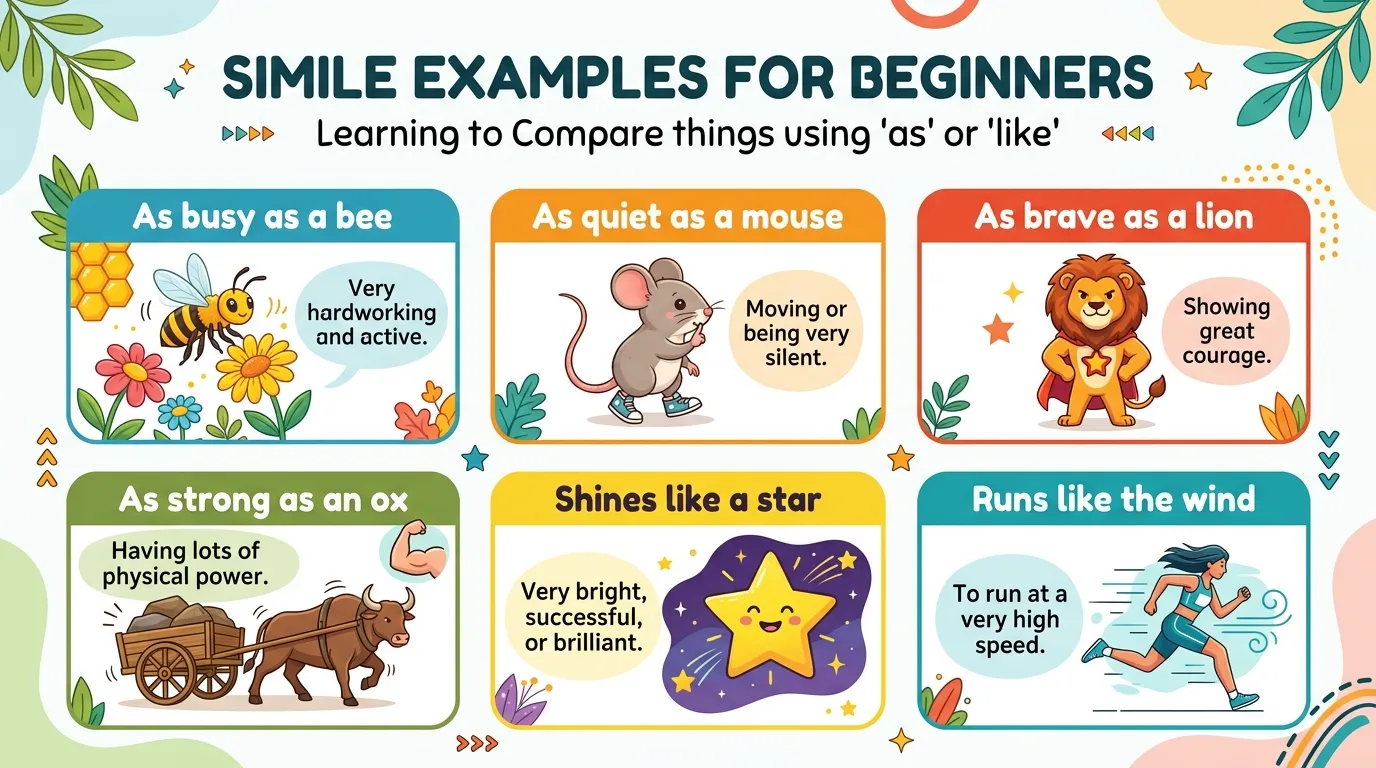
Learning similes can be simple and fun when you start with familiar words and everyday examples. A simile is a figure of speech that compares two unlike things using “like” or “as.” These comparisons help make writing more descriptive, colorful, and interesting.
If you’re a beginner, practicing simple similes is a great way to understand figurative language. Once you learn how comparisons work, you can use similes in stories, poems, essays, conversations, captions, and creative writing.
This guide includes 41 easy simile examples for beginners, along with their meanings, simple formulas, practice ideas, and helpful writing tips.
What Is a Simile?
A simile compares two different things using “like” or “as.”
For example:
She is as busy as a bee.
This doesn’t mean she is actually a bee. It means she is very busy.
Another example:
He runs like the wind.
This means he runs very fast.
41 Easy Simile Examples for Beginners
1. As brave as a lion
Meaning: Very brave.
2. As busy as a bee
Meaning: Very busy.
3. As quiet as a mouse
Meaning: Very quiet.
4. As light as a feather
Meaning: Very light.
5. As cold as ice
Meaning: Very cold.
6. As white as snow
Meaning: Very white.
7. As soft as a cloud
Meaning: Very soft.
8. As fast as lightning
Meaning: Extremely fast.
9. As strong as an ox
Meaning: Very strong.
10. As bright as the sun
Meaning: Very bright.
11. She sings like a bird.
Meaning: She sings beautifully.
12. He runs like the wind.
Meaning: He runs very quickly.
13. The baby slept like a log.
Meaning: The baby slept deeply.
14. Her eyes sparkle like stars.
Meaning: Her eyes look bright and beautiful.
15. The water was as smooth as glass.
Meaning: The water was very calm and smooth.
16. The pillow was as soft as cotton.
Meaning: The pillow was extremely soft.
17. He eats like a horse.
Meaning: He eats a lot.
18. She is as gentle as a butterfly.
Meaning: She is very gentle.
19. The boy jumped like a rabbit.
Meaning: He jumped quickly and energetically.
20. The moon looked like a silver coin.
Meaning: The moon looked round and shiny.
21. The stars shone like diamonds.
Meaning: The stars looked bright and sparkling.
22. His voice was as loud as thunder.
Meaning: His voice was very loud.
23. The kitten was as playful as a puppy.
Meaning: The kitten was very playful.
24. The road was as straight as an arrow.
Meaning: The road was very straight.
25. She was as happy as a child.
Meaning: She was extremely happy.
26. The classroom was as busy as a beehive.
Meaning: The classroom was full of activity.
27. The wind moved like a dancer.
Meaning: The wind moved gracefully.
28. His backpack was as heavy as a rock.
Meaning: His backpack was very heavy.
29. The snow fell like feathers.
Meaning: The snow fell softly.
30. The dog ran like a rocket.
Meaning: The dog ran very fast.
31. She was as calm as a lake.
Meaning: She was very peaceful.
32. His smile was like sunshine.
Meaning: His smile was warm and cheerful.
33. The cake was as sweet as honey.
Meaning: The cake was very sweet.
34. The baby was as cute as a teddy bear.
Meaning: The baby was very cute.
35. The leaves danced like butterflies.
Meaning: The leaves moved lightly in the wind.
36. He was as hungry as a wolf.
Meaning: He was extremely hungry.
37. The water was as clear as glass.
Meaning: The water was very clear.
38. She moved like a graceful swan.
Meaning: She moved elegantly.
39. The room was as dark as night.
Meaning: The room was very dark.
40. His hands were as cold as snow.
Meaning: His hands were very cold.
41. The flowers looked like colorful stars.
Meaning: The flowers looked bright and beautiful.
Simple Simile Formulas
Beginners can use two easy patterns.
Formula 1: Like
Subject + verb + like + comparison
Example:
The child runs like the wind.
Formula 2: As…As
Subject + is/was + as + adjective + as + comparison
Example:
The water was as cold as ice.
These two patterns make it easy to create your own similes.
How Beginners Can Create Similes
Follow these simple steps:
Step 1: Choose Something to Describe
For example: a runner
Step 2: Choose a Quality
The runner is fast.
Step 3: Think of Something Fast
You could choose:
- Lightning
- A rocket
- A cheetah
- An arrow
Step 4: Create Your Simile
The runner was as fast as a cheetah.
You can then make it more creative:
The runner moved like an arrow released from a bow.
Easy Simile Practice
Complete each sentence with your own comparison:
- As cold as ________.
- As bright as ________.
- As soft as ________.
- As fast as ________.
- As quiet as ________.
- As strong as ________.
- As happy as ________.
- She runs like ________.
- He sleeps like ________.
- The stars shine like ________.
Simile vs. Metaphor for Beginners
It is easy to confuse a simile with a metaphor.
A simile uses “like” or “as.”
The baby is like an angel.
A metaphor makes a direct comparison.
The baby is an angel.
Both are examples of figurative language, but their structures are different.
Common Beginner Mistakes
- Forgetting to use “like” or “as.”
- Confusing a simile with a metaphor.
- Taking the comparison literally.
- Choosing two things that have no clear connection.
- Making the sentence unnecessarily complicated.
- Using too many similes in one paragraph.
Tips for Learning Similes
- Start with familiar examples.
- Practice one adjective at a time.
- Use animals, nature, food, and everyday objects.
- Read children’s stories and poems.
- Create your own comparisons.
- Ask what quality the two things share.
- Keep your first similes short and simple.
Frequently Asked Questions
What is the easiest way to understand a simile?
Think of a simile as a comparison using “like” or “as.” For example, “as soft as a cloud” compares softness with a cloud.
What are some simple similes for beginners?
Examples include “as busy as a bee,” “as cold as ice,” “as light as a feather,” and “runs like the wind.”
Can beginners create their own similes?
Yes. Choose a quality, find something that represents that quality, and connect the two using “like” or “as.”
Why are similes useful?
Similes make descriptions more vivid, creative, clear, and memorable.
Are similes and metaphors the same?
No. Similes use “like” or “as,” while metaphors make direct comparisons.
Conclusion
These 41 simile examples for beginners provide an easy introduction to one of the most useful forms of figurative language. By learning simple comparisons such as “as brave as a lion” and “runs like the wind,” beginners can quickly understand how similes make ordinary descriptions more vivid.
The best way to learn is through practice. Start with simple words, create your own comparisons, and gradually experiment with more creative ideas. With regular practice, you’ll be able to use similes confidently in stories, poems, essays, conversations, and everyday writing.

Chris Woak is a passionate language enthusiast and the creative voice behind Mitaphor.com. With a deep interest in similes, metaphors, and word meanings, Chris simplifies complex expressions into clear, engaging explanations that readers of all levels can understand. His work focuses on helping students, writers, and language lovers explore the power of figurative language and improve their communication skills.