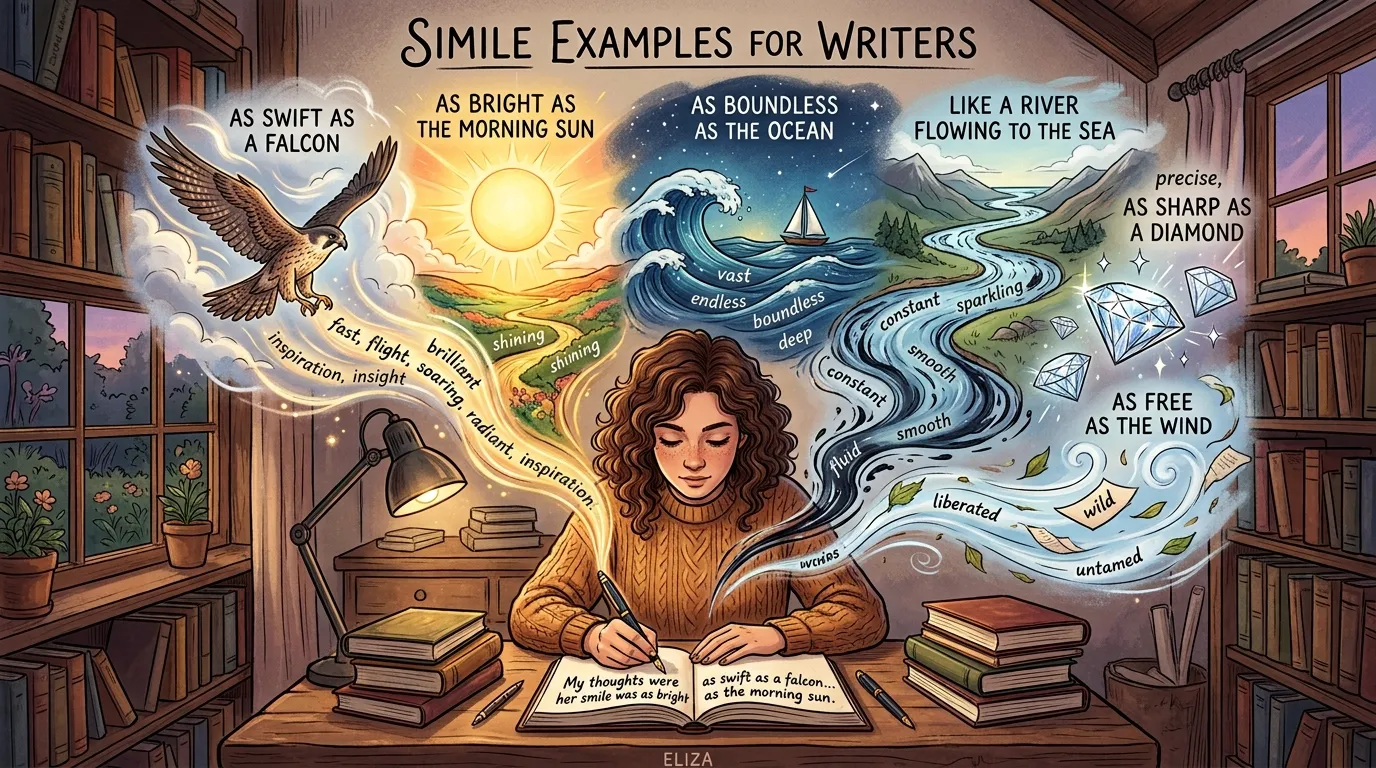
Simile examples for writers can transform ordinary sentences into vivid, memorable descriptions. A simile compares two unlike things using words such as “like” or “as.” Writers use similes to help readers visualize characters, settings, emotions, actions, and experiences more clearly.
Whether you’re writing a novel, short story, poem, essay, blog post, screenplay, or creative nonfiction, a strong simile can add depth and personality to your words. Instead of simply telling readers that a character is nervous, for example, you can show it through a comparison such as, “Her thoughts fluttered like trapped birds.”
This guide provides 53 simile examples for writers, organized by emotions, characters, nature, settings, actions, and storytelling situations. You’ll also learn how to create original similes and avoid common mistakes.
What Is a Simile?
A simile is a figure of speech that compares two unlike things using “like” or “as.”
For example:
The moon hung like a silver lantern above the village.
The moon isn’t literally a lantern. The comparison helps readers imagine its shape, brightness, and position.
Another example:
His hands were as cold as winter stones.
This comparison makes the character’s cold hands easier to visualize.
53 Simile Examples for Writers
Similes for Characters
1. As quiet as a shadow
The character is extremely quiet and difficult to notice.
2. As stubborn as an old oak
The character refuses to change their mind.
3. As sharp as a needle
The character is intelligent, observant, or quick-minded.
4. As gentle as a summer breeze
The character has a soft and caring personality.
5. As proud as a peacock
The character is extremely proud of themselves.
6. He moved like a cat in the darkness.
The character moves quietly, carefully, and gracefully.
7. Her eyes were like two burning stars.
Her eyes appear bright, intense, or passionate.
8. He stood as still as a statue.
The character remains completely motionless.
9. She was as restless as a bird in a cage.
The character feels trapped, impatient, or anxious.
10. His voice was like gravel beneath a boot.
His voice sounds rough, harsh, or unpleasant.
Similes for Emotions
11. Fear spread through him like wildfire.
Fear quickly becomes intense.
12. Her happiness was as bright as morning sunlight.
She feels extremely joyful.
13. Anger rose in him like a storm.
His anger grows rapidly and powerfully.
14. Her sadness hung over her like a heavy cloud.
She feels deeply unhappy.
15. Relief washed over him like warm rain.
He suddenly feels calm after experiencing worry.
16. Hope flickered like a candle in the darkness.
Hope is weak but still present.
17. Jealousy burned inside her like a hidden fire.
She experiences strong jealousy.
18. His loneliness was as deep as an empty ocean.
He feels extremely isolated.
19. Excitement raced through her like electricity.
She feels intensely excited.
20. His disappointment felt as heavy as a stone.
He feels emotionally weighed down.
Similes for Love and Relationships
21. Their love grew like ivy around an old wall.
Their relationship became stronger over time.
22. Her smile was like sunshine after a storm.
Her smile brought warmth and happiness.
23. Their connection was as strong as braided rope.
Their relationship was difficult to break.
24. His words were as gentle as falling snow.
His words were soft and comforting.
25. Their memories lingered like perfume in an empty room.
Their shared memories remained emotionally powerful.
Similes for Nature
26. The river curved through the valley like a silver ribbon.
The river’s shape and appearance are emphasized.
27. Clouds drifted across the sky like ships at sea.
The clouds appear to move slowly and peacefully.
28. The trees stood as tall as ancient towers.
The trees appeared extremely tall.
29. Rain tapped against the window like impatient fingers.
The comparison describes the sound and rhythm of the rain.
30. The wind rushed through the valley like a fleeing animal.
The wind moved quickly and dramatically.
31. The snow covered the ground like a white blanket.
The snow spread across the landscape.
32. The sunset burned like a river of fire.
The sunset appears intensely red, orange, and dramatic.
Similes for Settings
33. The abandoned house stood like a forgotten monument.
The house appears old, lonely, and significant.
34. The city glittered like a field of stars.
The lights of the city appeared bright and numerous.
35. The village was as quiet as a sleeping child.
The village was peaceful and silent.
36. The marketplace buzzed like a beehive.
The marketplace was crowded and energetic.
37. The hallway stretched before him like a dark tunnel.
The hallway feels long, mysterious, and intimidating.
38. The library was as silent as a snow-covered forest.
The setting was extremely quiet.
39. The battlefield looked like a storm had torn through it.
The scene appeared chaotic and damaged.
Similes for Actions and Movement
40. She ran like a deer startled by thunder.
She ran quickly and fearfully.
41. He slipped through the crowd like water through stones.
He moved smoothly through a crowded space.
42. The horse raced like an arrow across the field.
The horse moved extremely quickly.
43. The dancer moved like a leaf caught in the wind.
The dancer moved lightly and gracefully.
44. He charged forward as fiercely as a wounded lion.
He moved forward with great determination.
45. The door creaked like an old ship.
The door made a slow, unpleasant sound.
Similes for Time and Memory
46. Time slipped away like sand through his fingers.
Time passed quickly and could not be stopped.
47. The memory returned like an old song.
A familiar memory suddenly came back.
48. Childhood disappeared as quickly as morning mist.
Childhood seemed to pass very quickly.
49. The past followed her like a shadow.
Past experiences continued to affect her.
50. The years passed like pages turning in the wind.
Time moved quickly.
Similes for Writing and Creativity
51. Ideas arrived like rain after a long drought.
The writer suddenly has many creative ideas.
52. Words flowed from her pen like a river.
Writing came naturally and continuously.
53. His imagination was as vast as the open sky.
The writer had an enormous capacity for creative thinking.
How Writers Can Create Original Similes
Creating original similes doesn’t require complicated vocabulary. Start with something you want to describe and identify its strongest quality.
Step 1: Choose the Subject
For example:
A nervous character
Step 2: Identify the Quality
The character is:
- Restless
- Worried
- Uncertain
Step 3: Find a Strong Image
Think about something that behaves similarly.
A trapped bird is restless and anxious.
Step 4: Create the Comparison
Her thoughts fluttered like a trapped bird.
Step 5: Make It Specific
Instead of a generic comparison, connect it to your story’s setting and mood.
Her thoughts fluttered like a sparrow trapped beneath the old station roof.
This creates a stronger image and makes the simile feel connected to the story.
Similes for Different Types of Writing
Fiction
Use similes to describe:
- Characters
- Emotions
- Settings
- Weather
- Movement
- Conflict
Poetry
Similes can create emotional and visual imagery in a small number of words.
Creative Nonfiction
Use them to make real experiences easier for readers to visualize.
Blog Writing
Relevant similes can make explanations more engaging without overwhelming the reader.
Screenwriting
Short, powerful comparisons can help establish atmosphere and character quickly.
Tips for Writing Better Similes
Be Specific
Instead of:
She was like a bird.
Try:
She moved like a sparrow startled from a branch.
Match the Mood
A humorous scene needs a different comparison from a tragic scene.
Avoid Overused Clichés
Expressions such as “as busy as a bee” are familiar, but original comparisons often make writing more memorable.
Use Sensory Details
Think about sight, sound, touch, smell, and movement when developing a comparison.
Don’t Overuse Similes
A few powerful similes can be more effective than filling every sentence with comparisons.
Make the Comparison Meaningful
A good simile should reveal something about the subject rather than simply sound beautiful.
Common Mistakes Writers Should Avoid
- Using a comparison that doesn’t make sense.
- Mixing several unrelated similes together.
- Using clichés repeatedly.
- Making comparisons too long.
- Choosing imagery that conflicts with the scene.
- Adding similes where a simple sentence would be stronger.
- Using a simile without understanding what quality it communicates.
Simile vs. Metaphor
Writers often confuse these two literary devices.
A simile uses “like” or “as.”
Her voice was like music.
A metaphor makes a direct comparison.
Her voice was music.
Both can create strong imagery, but similes make the comparison more explicit.
Frequently Asked Questions
What are good similes for writers?
Good similes are specific, meaningful, and connected to the scene. Comparisons involving nature, weather, animals, objects, and sensory experiences can be especially effective.
How do I make a simile more creative?
Start with a familiar quality and connect it to an unexpected but understandable image. Specific details can make an ordinary comparison feel original.
Can similes improve storytelling?
Yes. Similes can help readers visualize characters, settings, emotions, and actions while creating a stronger emotional connection to the story.
Should writers avoid common similes?
Not completely. Common similes can be useful when they communicate an idea quickly, but original comparisons can make your writing more distinctive.
How many similes should I use in my writing?
There is no fixed number. Use similes when they add imagery, emotion, clarity, or meaning. Avoid adding them simply because you can.
Conclusion
These 53 simile examples for writers demonstrate how comparisons can bring characters, emotions, settings, and stories to life. A strong simile doesn’t simply decorate a sentence—it gives readers a way to see, hear, feel, or understand what the writer is describing.
When creating your own similes, focus on specific imagery, meaningful connections, and the mood of your scene. Experiment with nature, animals, weather, memories, sounds, and everyday experiences to discover fresh comparisons. With practice, similes can become one of the most effective tools in your writing toolkit.

Chris Woak is a passionate language enthusiast and the creative voice behind Mitaphor.com. With a deep interest in similes, metaphors, and word meanings, Chris simplifies complex expressions into clear, engaging explanations that readers of all levels can understand. His work focuses on helping students, writers, and language lovers explore the power of figurative language and improve their communication skills.