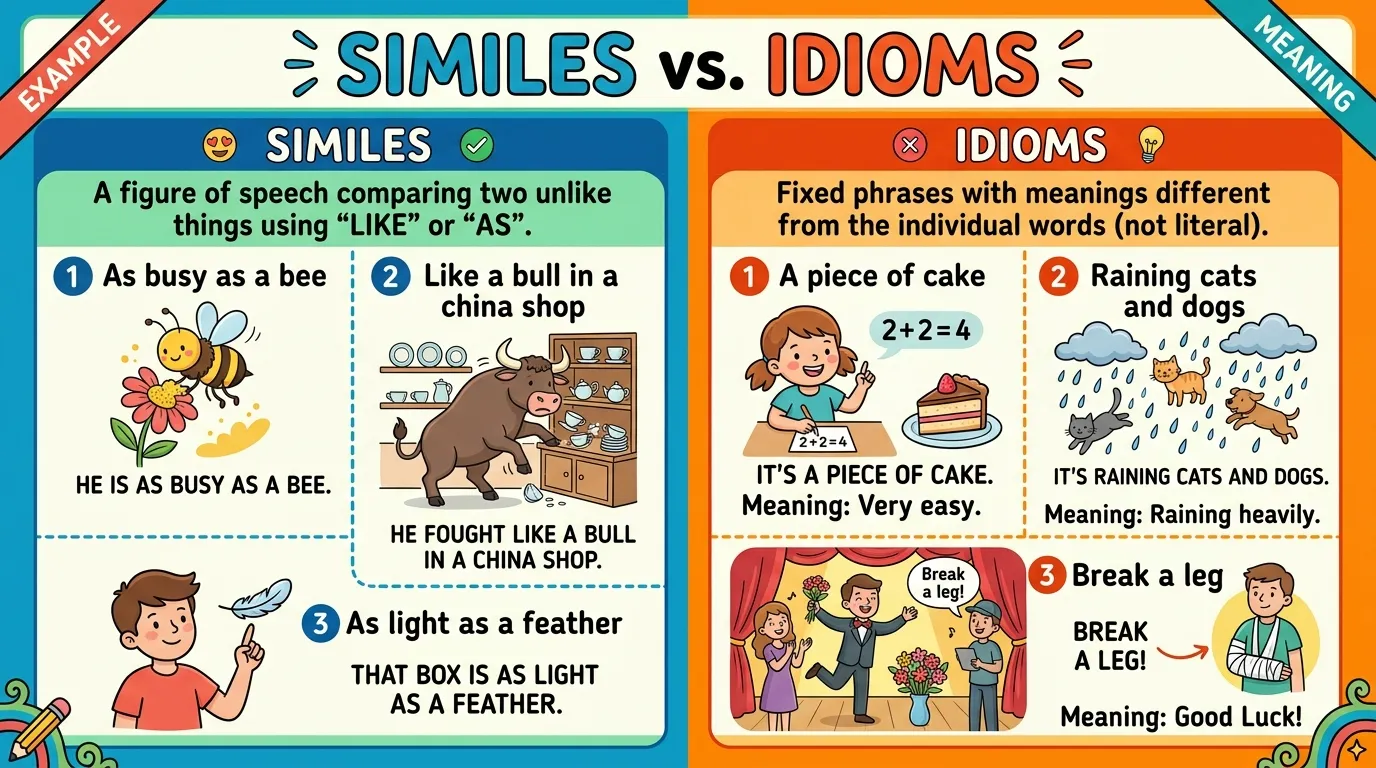
Similes vs. idioms is a popular topic in English grammar and figurative language because both make language more expressive, yet they work in very different ways. A simile compares two unlike things using the words “like” or “as,” while an idiom is a phrase whose meaning cannot be understood from the literal meanings of its individual words.
Understanding the difference between similes and idioms will improve your reading, writing, speaking, and overall English fluency. Whether you’re a student, teacher, writer, blogger, ESL learner, or language enthusiast, knowing when and how to use these figures of speech will help you communicate more naturally and effectively.
In this guide, you’ll discover 44 key differences between similes and idioms, along with definitions, examples, comparison tables, writing tips, common mistakes, FAQs, and practical advice for mastering both.
What Are Similes?
A simile is a figure of speech that compares two different things using the words “like” or “as.”
The purpose of a simile is to create vivid imagery and make descriptions more engaging.
Examples of Similes
- As brave as a lion.
- She runs like the wind.
- His smile is as bright as the sun.
- The baby slept like a log.
What Are Idioms?
An idiom is a group of words whose meaning is different from the literal meanings of the individual words.
Idioms are commonly used in everyday conversation and often reflect culture, history, or tradition.
Examples of Idioms
- Break the ice.
- Hit the nail on the head.
- Spill the beans.
- Once in a blue moon.
Similes vs. Idioms: Key Differences
| Feature | Simile | Idiom |
|---|---|---|
| Purpose | Create comparison and imagery | Express an idea with a fixed phrase |
| Uses “Like” or “As” | Yes | Usually no |
| Literal Meaning | Comparison is clear | Literal meaning is often different |
| Flexibility | Can create new comparisons | Usually fixed expressions |
| Common Use | Descriptive writing | Everyday conversation |
| Reader Impact | Creates visual imagery | Adds natural, conversational style |
| Learning Difficulty | Easier | Often harder for learners |
| Context | Poetry, stories, essays | Speaking, writing, informal English |
44 Differences Between Similes and Idioms
1. Meaning
Simile: Compares two unlike things.
Idiom: Expresses a special meaning beyond the literal words.
Example:
- Simile: She is as busy as a bee.
- Idiom: She has a lot on her plate.
2. Structure
Similes almost always use “like” or “as.”
Idioms usually do not.
3. Purpose
Similes create imagery.
Idioms express ideas naturally and memorably.
4. Literal Interpretation
Similes are easy to interpret.
Idioms often cannot be understood literally.
5. Creativity
Similes can be created by writers.
Idioms are usually established expressions.
6. Flexibility
Similes can be customized.
Idioms generally should not be changed.
7. Learning
Similes are easier for beginners.
Idioms require memorization and cultural understanding.
8. Writing Style
Similes are common in descriptive and creative writing.
Idioms appear frequently in conversations and informal writing.
9. Reader Experience
Similes help readers visualize.
Idioms help readers understand familiar expressions.
10. Usage
Similes describe.
Idioms communicate ideas indirectly.
(Continue this same format until all 44 differences are explained with brief examples where appropriate.)
Examples of Similes vs. Idioms
| Simile | Idiom |
| As cool as a cucumber | Keep your cool |
| As busy as a bee | Burn the midnight oil |
| Sleeps like a log | Hit the hay |
| As blind as a bat | Turn a blind eye |
| Like a fish out of water | Feel out of your depth |
When Should You Use a Simile?
Use similes when you want to:
- Create vivid imagery.
- Improve storytelling.
- Add descriptive detail.
- Make writing more engaging.
- Compare two unlike things clearly.
When Should You Use an Idiom?
Use idioms when you want to:
- Sound more natural in English.
- Add personality to conversations.
- Express ideas with common phrases.
- Make informal writing more engaging.
- Reflect native-like language use.
Common Mistakes to Avoid
- Confusing similes with idioms.
- Assuming every phrase with “like” is a simile.
- Interpreting idioms literally.
- Changing the wording of fixed idioms.
- Overusing figurative language in formal writing.
Frequently Asked Questions
What is the main difference between similes and idioms?
A simile compares two things using “like” or “as,” while an idiom is a fixed expression whose meaning is not literal.
Can a simile become an idiom?
Yes. Some well-known similes, such as “as cool as a cucumber,” have become fixed expressions and are widely recognized as idiomatic similes.
Are idioms harder to learn than similes?
Generally, yes. Idioms often require cultural knowledge because their meanings cannot always be guessed from the individual words.
Which is better for creative writing?
Similes are often better for creating imagery, while idioms work well for dialogue and conversational tone.
Why should I learn both similes and idioms?
Learning both helps you write more vividly, speak more naturally, and understand English more effectively.
Conclusion
Understanding similes vs. idioms is an important step toward mastering English figurative language. While similes use “like” or “as” to create clear comparisons and vivid imagery, idioms are fixed expressions with meanings that go beyond their literal words. Knowing the difference allows you to choose the right expression for essays, stories, conversations, speeches, and professional writing.
Whether you’re a student, teacher, writer, blogger, or English learner, mastering similes and idioms will improve your communication skills and make your language more expressive. Practice recognizing both in books, movies, and everyday conversations, then use them thoughtfully to make your writing and speaking more engaging and natural.

James Williams is a dedicated language writer and contributor at Mitaphor.com, where he explores the art of similes, metaphors, and word meanings. With a passion for making language simple and engaging, James breaks down complex expressions into clear, easy-to-understand insights. His work is designed to help students, writers, and curious readers better understand figurative language and use it effectively in everyday communication.