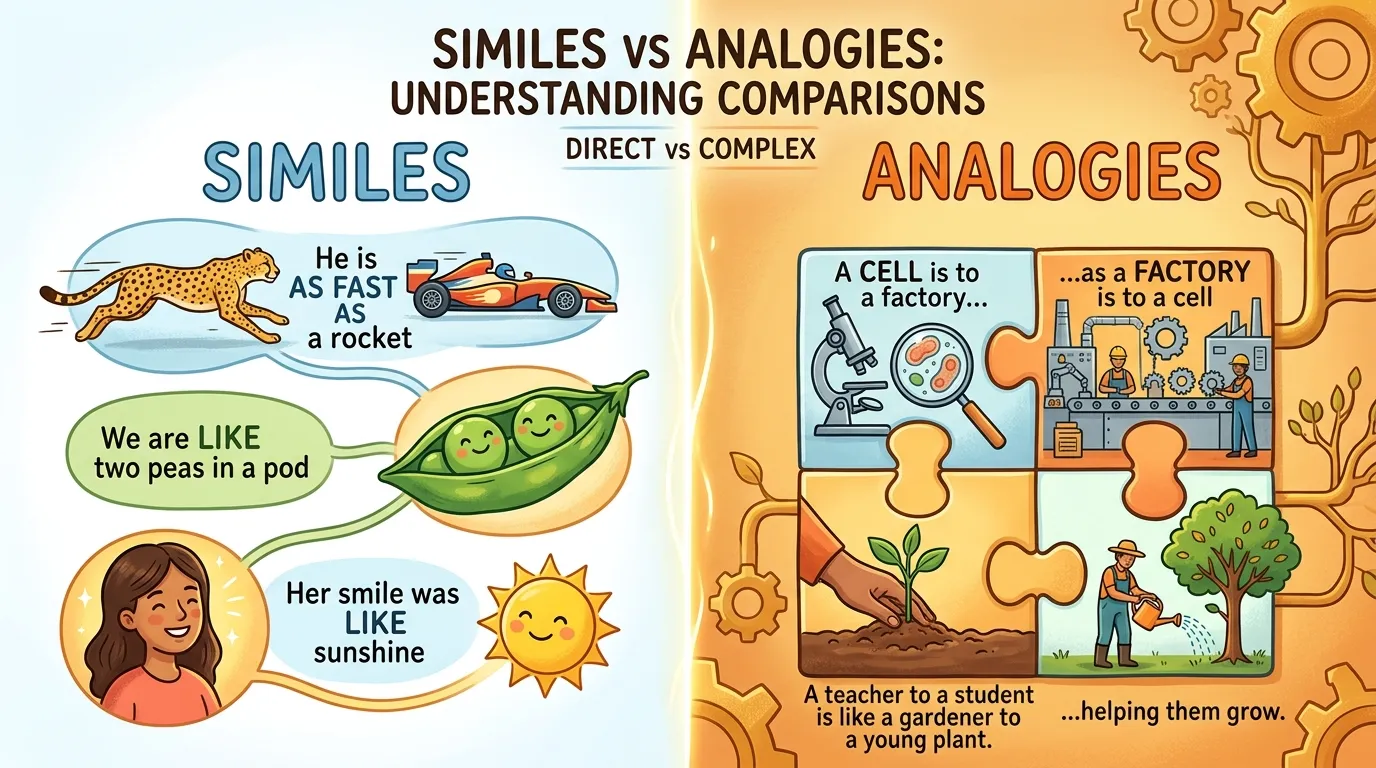
Similes vs. analogies is a common topic in English grammar, figurative language, and creative writing. While both compare two different things to explain ideas or create understanding, they serve different purposes. A simile makes a direct comparison using the words “like” or “as,” whereas an analogy is a broader comparison that explains a concept by showing how two different situations or relationships are similar.
Understanding the difference between similes and analogies will improve your writing, speaking, teaching, storytelling, and critical thinking. Whether you’re a student, teacher, writer, blogger, or English learner, knowing when to use each technique will make your communication clearer and more effective.
In this guide, you’ll learn 41 key differences between similes and analogies, along with definitions, examples, writing tips, common mistakes, FAQs, and practical advice for using both correctly.
What Are Similes?
A simile is a figure of speech that compares two unlike things using the words “like” or “as.”
Its purpose is to create vivid imagery and make descriptions more interesting.
Examples of Similes
- As brave as a lion.
- She sings like a bird.
- The baby slept like a log.
- His smile is as bright as the sun.
What Are Analogies?
An analogy is a comparison between two different ideas, situations, or relationships to explain a concept or make it easier to understand.
Unlike a simile, an analogy may include several sentences or an entire paragraph to develop the comparison.
Examples of Analogies
- A teacher is like a gardener who helps students grow.
- Running a business is like steering a ship through changing weather.
- Learning a language is like building a house—each lesson adds another brick.
- The human brain works like a computer processing information.
Similes vs. Analogies: Key Differences
| Feature | Simile | Analogy |
|---|---|---|
| Purpose | Create imagery | Explain an idea or relationship |
| Comparison Style | Direct comparison | Extended comparison |
| Uses “Like” or “As” | Usually yes | Sometimes, but not always |
| Length | Usually one sentence | One sentence to several paragraphs |
| Main Goal | Add description | Improve understanding |
| Common Use | Poetry, stories, everyday speech | Teaching, science, business, writing |
| Reader Impact | Creates vivid images | Clarifies complex concepts |
| Complexity | Simple | More detailed |
41 Differences Between Similes and Analogies
1. Purpose
Simile: Adds descriptive imagery.
Analogy: Explains unfamiliar ideas through comparison.
Example:
- Simile: Her smile is like sunshine.
- Analogy: A smile can brighten someone’s day just as sunshine brightens the morning.
2. Length
Similes are usually short.
Analogies can be much longer and more detailed.
3. Function
Similes focus on description.
Analogies focus on explanation.
4. Complexity
Similes are straightforward.
Analogies often involve multiple related ideas.
5. Usage
Similes commonly appear in poems, novels, and conversations.
Analogies are often used in education, presentations, science, and persuasive writing.
6. Reader Experience
Similes help readers imagine.
Analogies help readers understand.
7. Structure
Similes almost always use “like” or “as.”
Analogies may compare ideas with or without those words.
8. Detail
Similes usually describe one quality.
Analogies explain several similarities.
9. Purpose in Learning
Similes make writing colorful.
Analogies make learning easier.
10. Creativity
Both are creative, but analogies often require deeper reasoning and more explanation.
(Continue this same format until all 41 differences are explained with brief examples where appropriate.)
Examples of Similes vs. Analogies
| Simile | Analogy |
| As busy as a bee | A successful team works like a beehive, where every member has an important role. |
| Like a flowing river | Life is like a river because it constantly moves forward despite obstacles. |
| As bright as a star | A mentor is like a star, providing guidance even during life’s darkest moments. |
| As strong as an ox | Building a career is like climbing a mountain—it takes effort, patience, and persistence. |
| Like a feather | Solving a puzzle is like solving a real-life problem by putting small pieces together. |
When Should You Use a Simile?
Use similes when you want to:
- Create vivid imagery.
- Make descriptions more engaging.
- Improve storytelling.
- Add emotion to writing.
- Keep comparisons short and memorable.
When Should You Use an Analogy?
Use analogies when you want to:
- Explain difficult concepts.
- Teach or train others.
- Strengthen persuasive writing.
- Simplify technical ideas.
- Connect unfamiliar ideas to familiar experiences.
Common Mistakes to Avoid
- Confusing a short simile with a full analogy.
- Assuming every analogy uses “like” or “as.”
- Overcomplicating simple comparisons.
- Using unrelated comparisons that confuse readers.
- Mixing multiple analogies in the same explanation.
Frequently Asked Questions
What is the main difference between similes and analogies?
A simile is a brief comparison using “like” or “as,” while an analogy is a broader comparison used to explain an idea or relationship.
Is every simile an analogy?
No. A simile is a specific type of figurative comparison, while an analogy is an explanatory comparison that may include one or more similes.
Can an analogy contain a simile?
Yes. Many analogies begin with or include a simile to make the explanation clearer.
Which is better for teaching?
Analogies are usually better because they explain concepts in greater depth, while similes are better for adding descriptive imagery.
Why are similes and analogies important?
They make communication more engaging, improve understanding, and help readers connect new ideas with familiar experiences.
Conclusion
Understanding similes vs. analogies is essential for becoming a stronger writer and communicator. Although both compare different things, similes are short, descriptive comparisons that use “like” or “as,” while analogies are more detailed comparisons designed to explain ideas and relationships. Knowing when to use each technique will improve your essays, speeches, presentations, creative writing, and everyday communication.
Whether you’re a student, teacher, writer, blogger, or English learner, mastering similes and analogies will help you express ideas more clearly and creatively. Practice identifying both in books, articles, and conversations, then use them thoughtfully to make your own writing more vivid, persuasive, and easy to understand.

James Williams is a dedicated language writer and contributor at Mitaphor.com, where he explores the art of similes, metaphors, and word meanings. With a passion for making language simple and engaging, James breaks down complex expressions into clear, easy-to-understand insights. His work is designed to help students, writers, and curious readers better understand figurative language and use it effectively in everyday communication.