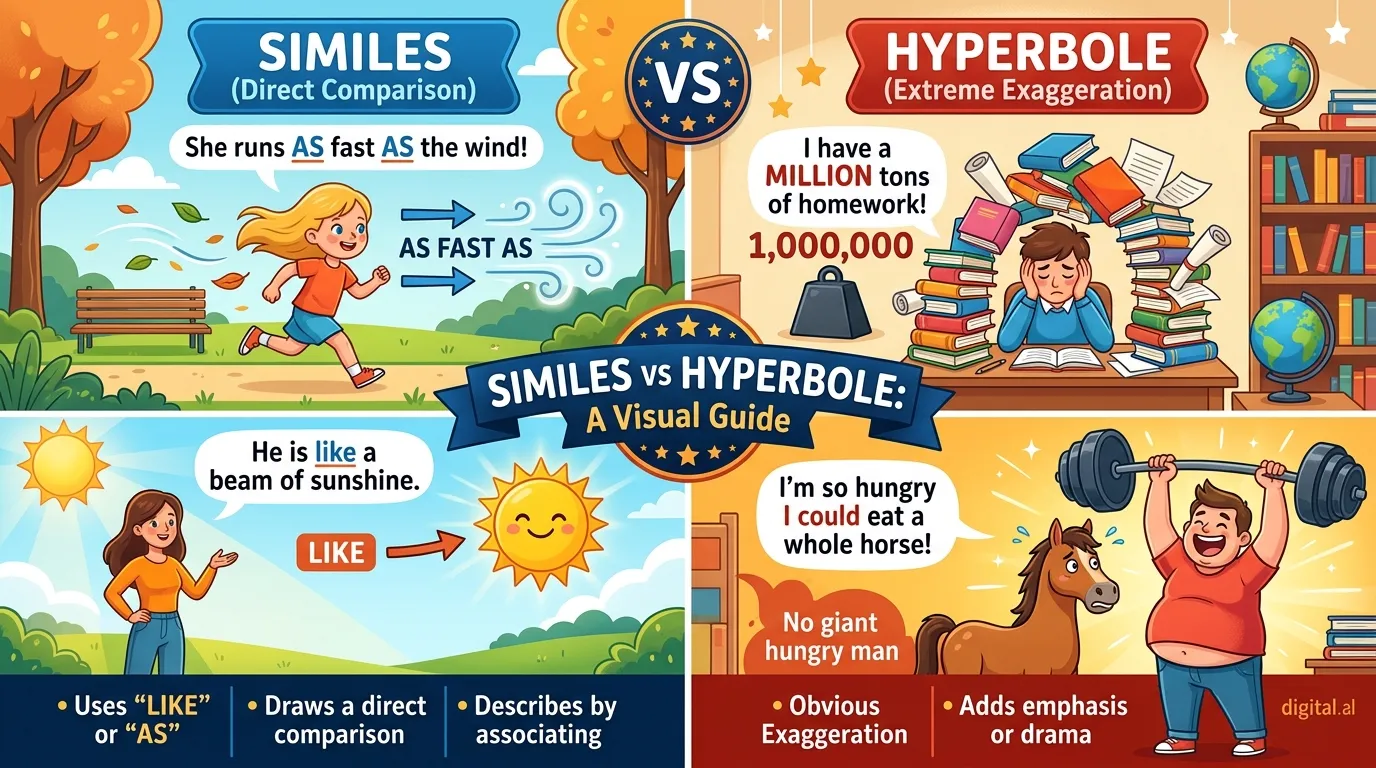
Similes vs. hyperbole is a key topic in English grammar and figurative language because both make writing more vivid and engaging, yet they serve different purposes. A simile compares two unlike things using the words “like” or “as,” while hyperbole uses intentional exaggeration to emphasize an idea, feeling, or situation without being taken literally.
Understanding the difference between similes and hyperbole can improve your essays, stories, speeches, poetry, and everyday communication. Whether you’re a student, teacher, writer, blogger, or English learner, mastering these literary devices will help you write with greater creativity, clarity, and impact.
In this guide, you’ll discover 45 key differences between similes and hyperbole, along with definitions, examples, comparison tables, writing tips, common mistakes, FAQs, and practical advice for using both effectively.
What Are Similes?
A simile is a figure of speech that compares two unlike things using the words “like” or “as.”
Its purpose is to create vivid imagery and help readers visualize an idea more clearly.
Examples of Similes
- As brave as a lion.
- She runs like the wind.
- His smile is as bright as the sun.
- The baby slept like a log.
What Is Hyperbole?
Hyperbole is a figure of speech that uses deliberate exaggeration to emphasize a point or express strong emotions. It is not meant to be understood literally.
Hyperbole makes writing more dramatic, humorous, or emotionally powerful.
Examples of Hyperbole
- I’ve told you a million times.
- This bag weighs a ton.
- I’m so hungry I could eat a horse.
- That movie lasted forever.
Similes vs. Hyperbole: Key Differences
| Feature | Simile | Hyperbole |
|---|---|---|
| Purpose | Compare two unlike things | Exaggerate for emphasis |
| Uses “Like” or “As” | Yes | Usually no |
| Main Focus | Similarity | Exaggeration |
| Literal Meaning | Clearly figurative | Clearly exaggerated |
| Common Use | Descriptive writing | Conversation, humor, storytelling |
| Reader Impact | Creates vivid imagery | Creates dramatic emphasis |
| Flexibility | Easy to create | Depends on intentional overstatement |
| Best For | Visual descriptions | Expressing strong emotions or reactions |
45 Differences Between Similes and Hyperbole
1. Definition
Simile: Compares two unlike things using “like” or “as.”
Hyperbole: Deliberately exaggerates something for emphasis.
Example:
- Simile: He is as strong as an ox.
- Hyperbole: He is the strongest person in the universe.
2. Purpose
Similes explain similarities.
Hyperbole emphasizes intensity.
3. Structure
Similes usually include “like” or “as.”
Hyperbole relies on obvious exaggeration.
4. Imagery
Similes create visual comparisons.
Hyperbole creates dramatic effects.
5. Accuracy
Similes compare realistically.
Hyperbole intentionally goes beyond reality.
6. Emotional Impact
Similes make descriptions vivid.
Hyperbole amplifies emotions.
7. Writing Style
Similes are common in descriptive writing.
Hyperbole is common in humor, advertising, speeches, and storytelling.
8. Reader Experience
Similes help readers imagine.
Hyperbole helps readers feel intensity.
9. Literal Meaning
Neither should be taken literally.
However, hyperbole is intentionally impossible or highly exaggerated.
10. Creativity
Similes compare creatively.
Hyperbole exaggerates creatively.
(Continue this same format until all 45 differences are explained with brief examples where appropriate.)
Examples of Similes vs. Hyperbole
| Simile | Hyperbole |
| As light as a feather | This weighs nothing at all. |
| As busy as a bee | I’m drowning in work. |
| As cold as ice | I’m freezing to death. |
| Like a rocket | It traveled faster than light. |
| As quiet as a mouse | You could hear a pin drop from miles away. |
When Should You Use a Simile?
Use similes when you want to:
- Create vivid comparisons.
- Improve descriptive writing.
- Help readers visualize ideas.
- Add imagery to stories.
- Make explanations more engaging.
When Should You Use Hyperbole?
Use hyperbole when you want to:
- Emphasize strong emotions.
- Add humor or drama.
- Make dialogue more expressive.
- Capture attention in speeches or advertisements.
- Highlight excitement or urgency.
Common Mistakes to Avoid
- Confusing comparison with exaggeration.
- Assuming every exaggeration is a hyperbole.
- Forgetting that similes use “like” or “as.”
- Overusing hyperbole in formal or academic writing.
- Mixing figurative devices in ways that confuse readers.
Frequently Asked Questions
What is the main difference between similes and hyperbole?
A simile compares two unlike things using “like” or “as,” while hyperbole uses intentional exaggeration to emphasize a point or emotion.
Can a sentence contain both a simile and hyperbole?
Yes. For example: He ran like the wind and covered a million miles in one day. The phrase “like the wind” is a simile, while “a million miles” is hyperbole.
Is hyperbole a type of simile?
No. They are different figures of speech with different purposes.
Which is better for creative writing?
Both are useful. Similes create vivid imagery, while hyperbole adds excitement, humor, and dramatic emphasis.
Why should I learn both similes and hyperbole?
Understanding both improves descriptive writing, storytelling, public speaking, and overall communication.
Conclusion
Understanding similes vs. hyperbole is essential for using figurative language effectively. While similes compare two unlike things using “like” or “as,” hyperbole intentionally exaggerates to create emphasis, humor, or emotional impact. Knowing the difference allows you to choose the right technique for essays, speeches, stories, poems, advertisements, and everyday conversations.
Whether you’re a student, teacher, writer, blogger, or English learner, mastering similes and hyperbole will strengthen your writing and communication skills. Practice identifying these literary devices in books, movies, songs, and conversations, then use them thoughtfully to make your own writing more vivid, persuasive, and memorable.

Chris Woak is a passionate language enthusiast and the creative voice behind Mitaphor.com. With a deep interest in similes, metaphors, and word meanings, Chris simplifies complex expressions into clear, engaging explanations that readers of all levels can understand. His work focuses on helping students, writers, and language lovers explore the power of figurative language and improve their communication skills.