Similes with explanations make it easier to understand how figurative language works in English. A simile compares two different things using words such as “like” or “as” to highlight a shared quality. Instead of giving a plain description, a simile creates a familiar picture that helps readers understand an idea more clearly.
For example, saying “She is very kind” gives a straightforward description. But saying “She is as gentle as a lamb” creates a stronger image of someone who is caring, peaceful, and kind. The comparison makes the sentence more expressive and helps the reader connect the description with something familiar.
Similes are used throughout the English language. You can find them in children’s books, novels, poems, essays, speeches, advertisements, classroom activities, social media captions, and everyday conversations. Some are traditional expressions that most English speakers recognize, while others are creative comparisons developed by individual writers.
Understanding similes is particularly useful for students, English learners, teachers, writers, and content creators. Students can use them to improve descriptive writing and identify figurative language. English learners can expand their vocabulary by learning common expressions and their meanings. Writers can use similes to create stronger imagery, describe emotions, develop characters, and make their writing more memorable.
In this guide, you will find 74 similes with clear explanations and example sentences. Each example explains what the comparison means, why it works, and how you can use it naturally. You will also learn the basic structure of similes, common mistakes, differences between similes and metaphors, and practical tips for creating your own.
What Is a Simile?
A simile is a figure of speech that directly compares two unlike things, commonly using “like” or “as.”
For example:
He is as brave as a lion.
This does not mean that he is literally a lion. Instead, his courage is compared with the bravery associated with a lion.
Another example is:
The children ran like rabbits.
The children are not rabbits. The comparison emphasizes that they moved quickly and energetically.
Why Are Similes Important?
Similes make writing and speech more descriptive, emotional, and memorable.
They can help you:
- Create vivid imagery.
- Explain difficult ideas.
- Describe people and personalities.
- Express emotions.
- Make stories more engaging.
- Improve creative writing.
- Add personality to everyday speech.
- Develop stronger vocabulary.
Compare:
The lake was calm.
with:
The lake was as smooth as glass.
The second sentence gives the reader a much clearer visual image.
74 Similes With Explanations
1. As Brave as a Lion
Meaning: Extremely courageous.
Explanation: Lions are commonly associated with courage and strength. Comparing someone to a lion emphasizes that they are not easily frightened.
Example:
The firefighter was as brave as a lion when he entered the burning building.
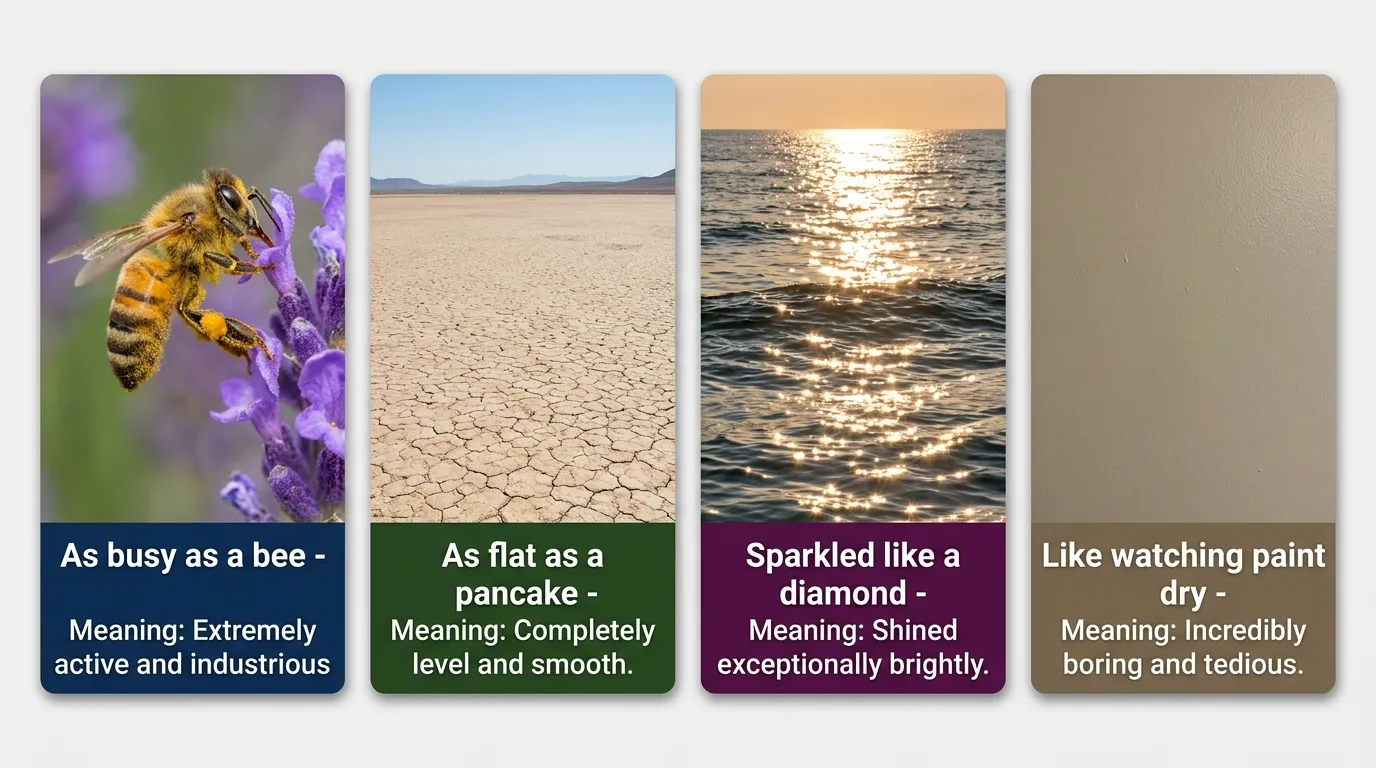
2. As Busy as a Bee
Meaning: Extremely busy and active.
Explanation: Bees spend much of their time working and moving from place to place. This makes a bee a familiar symbol of constant activity.
Example:
My mother has been as busy as a bee preparing for the wedding.
3. As Quiet as a Mouse
Meaning: Very quiet.
Explanation: Mice are often imagined as small, cautious creatures that move without making much noise.
Example:
The students were as quiet as mice during the examination.
4. As Strong as an Ox
Meaning: Extremely strong.
Explanation: Oxen are traditionally associated with physical strength and hard work.
Example:
The old farmer is as strong as an ox.
5. As Wise as an Owl
Meaning: Very wise and knowledgeable.
Explanation: Owls are traditionally associated with wisdom, especially in stories and cultural symbolism.
Example:
Grandfather is as wise as an owl and always gives us good advice.
6. As Proud as a Peacock
Meaning: Extremely proud.
Explanation: Peacocks are famous for displaying their colorful feathers, so they are often used to symbolize pride.
Example:
He looked as proud as a peacock after receiving the award.
7. As Cold as Ice
Meaning: Extremely cold.
Explanation: Ice is naturally associated with very low temperatures, making it an easy comparison for intense cold.
Example:
My hands were as cold as ice.
8. As White as Snow
Meaning: Very white.
Explanation: Fresh snow is commonly associated with a bright white appearance.
Example:
The mountain peaks were as white as snow.
9. As Soft as Silk
Meaning: Very soft and smooth.
Explanation: Silk is known for its smooth, delicate texture, so it is often used as a comparison for softness.
Example:
The fabric felt as soft as silk.
10. As Light as a Feather
Meaning: Extremely light.
Explanation: A feather weighs very little, making it a natural comparison for something that is easy to lift or carry.
Example:
The package was as light as a feather.
11. As Fast as Lightning
Meaning: Extremely fast.
Explanation: Lightning appears suddenly and moves extremely quickly, making it a powerful comparison for speed.
Example:
The athlete was as fast as lightning.
12. As Sweet as Honey
Meaning: Very sweet, pleasant, or kind.
Explanation: Honey has a naturally sweet taste, so this simile can describe both literal sweetness and a person’s pleasant personality.
Example:
Her personality is as sweet as honey.
13. As Clear as Glass
Meaning: Very clear.
Explanation: Clean glass allows you to see through it easily, so it is commonly compared with clarity.
Example:
The water was as clear as glass.
14. As Hungry as a Wolf
Meaning: Extremely hungry.
Explanation: Wolves are often portrayed as animals with strong appetites, making them a familiar comparison for intense hunger.
Example:
After the long journey, we were as hungry as wolves.
15. As Gentle as a Lamb
Meaning: Very gentle and peaceful.
Explanation: Lambs are commonly associated with innocence, softness, and gentleness.
Example:
The teacher was as gentle as a lamb with the nervous child.
16. As Sly as a Fox
Meaning: Very clever or cunning.
Explanation: Foxes frequently appear in stories as clever animals that use intelligence to solve problems or escape danger.
Example:
The detective was as sly as a fox.
17. As Stubborn as a Mule
Meaning: Very unwilling to change one’s mind.
Explanation: Mules have a reputation for being difficult to persuade, making them a common symbol of stubbornness.
Example:
He is as stubborn as a mule.
18. As Happy as a Lark
Meaning: Extremely happy.
Explanation: The pleasant sound of a singing lark has traditionally been connected with joy and happiness.
Example:
She was as happy as a lark after hearing the good news.
19. As Cool as a Cucumber
Meaning: Very calm.
Explanation: This expression describes someone who remains calm even in a stressful or difficult situation.
Example:
Everyone panicked, but Sarah stayed as cool as a cucumber.
20. As Easy as Pie
Meaning: Very easy.
Explanation: This familiar expression is used when something requires little effort or difficulty.
Example:
The math problem was as easy as pie.
21. As Sharp as a Razor
Meaning: Very intelligent, alert, or observant.
Explanation: A razor has an extremely sharp edge, so the comparison suggests a person’s mind or observations are equally sharp.
Example:
Her mind is as sharp as a razor.
22. As Bright as the Sun
Meaning: Extremely bright or cheerful.
Explanation: The sun is one of the brightest natural objects people commonly encounter. The comparison can describe light, appearance, or personality.
Example:
Her smile was as bright as the sun.
23. As Dark as Night
Meaning: Extremely dark.
Explanation: Night is associated with darkness, so it provides a familiar image for a place or situation with very little light.
Example:
The basement was as dark as night.
24. As Smooth as Glass
Meaning: Extremely smooth.
Explanation: A clean piece of glass has a flat, even surface with very little roughness.
Example:
The surface of the lake was as smooth as glass.
25. As Graceful as a Swan
Meaning: Very elegant.
Explanation: Swans are often admired for their smooth movements and elegant appearance.
Example:
The dancer moved as gracefully as a swan.
26. As Fresh as a Daisy
Meaning: Fresh, healthy, and energetic.
Explanation: A fresh daisy represents natural freshness and vitality.
Example:
She looked as fresh as a daisy after her morning walk.
27. As Red as a Tomato
Meaning: Extremely red.
Explanation: A ripe tomato has a strong red color. The expression is often used for someone’s face when they are embarrassed, angry, or overheated.
Example:
His face became as red as a tomato.
28. As Flat as a Pancake
Meaning: Very flat.
Explanation: A pancake has a broad, thin shape, making it a familiar comparison for something unusually flat.
Example:
The tire was as flat as a pancake.
29. As Pale as a Ghost
Meaning: Extremely pale.
Explanation: Ghosts are traditionally imagined as pale or white. This simile often describes someone who is frightened or shocked.
Example:
She became as pale as a ghost when she heard the news.
30. As Hard as a Rock
Meaning: Extremely hard.
Explanation: Rocks are solid and difficult to bend or break, making them a natural comparison for hardness.
Example:
The frozen ground was as hard as a rock.
31. As Heavy as Lead
Meaning: Extremely heavy.
Explanation: Lead is a dense metal that feels very heavy for its size.
Example:
The suitcase felt as heavy as lead.
32. As Calm as a Lake
Meaning: Very peaceful and relaxed.
Explanation: A still lake can appear completely peaceful, making it a useful image for emotional calmness.
Example:
After meditating, she felt as calm as a lake.
33. As Old as the Hills
Meaning: Extremely old.
Explanation: Hills and mountains have existed for enormous periods of time, so this comparison emphasizes age.
Example:
That tradition is as old as the hills.
34. As Busy as an Ant
Meaning: Very hardworking and active.
Explanation: Ants are known for working together and constantly carrying out tasks.
Example:
The children were as busy as ants preparing the decorations.
35. As Hungry as a Horse
Meaning: Extremely hungry.
Explanation: Horses are large animals that eat substantial amounts of food, so they are often used to represent a strong appetite.
Example:
After practice, I was as hungry as a horse.
36. As Blind as a Bat
Meaning: Unable to see clearly or notice something.
Explanation: This traditional expression comes from the old belief that bats have very poor eyesight. In reality, bats are not simply “blind.”
Example:
Without my glasses, I feel as blind as a bat.
37. As Thin as a Needle
Meaning: Extremely thin.
Explanation: A needle has a very narrow shape, making it a useful comparison for something extremely thin.
Example:
The crack was as thin as a needle.
38. As Busy as a Clock
Meaning: Constantly active.
Explanation: A clock is always working and moving, making it a creative comparison for continuous activity.
Example:
She was as busy as a clock throughout the day.
39. Like a Breath of Fresh Air
Meaning: Something refreshing or pleasantly different.
Explanation: Fresh air feels refreshing, so the phrase describes a person, idea, or experience that brings new energy.
Example:
Her positive attitude was like a breath of fresh air.
40. Like Two Peas in a Pod
Meaning: Two people who are extremely similar or very close.
Explanation: Peas inside the same pod are naturally close together and look similar.
Example:
The sisters are like two peas in a pod.
41. Run Like the Wind
Meaning: Run extremely quickly.
Explanation: Wind can move rapidly and cannot easily be stopped, so it represents great speed.
Example:
The boy ran like the wind toward the finish line.
42. Sleep Like a Log
Meaning: Sleep very deeply.
Explanation: A log does not move, so this comparison describes someone who sleeps heavily and remains still.
Example:
I slept like a log after the long trip.
43. Sing Like a Bird
Meaning: Sing beautifully or naturally.
Explanation: Birds are associated with pleasant singing, especially in poetry and everyday expressions.
Example:
She can sing like a bird.
44. Shine Like a Star
Meaning: Stand out or perform exceptionally well.
Explanation: Stars are bright and noticeable, so shining like a star suggests excellence or distinction.
Example:
She shone like a star during the performance.
45. Move Like a Shadow
Meaning: Move quietly and almost unnoticed.
Explanation: A shadow follows movement silently and does not make noise.
Example:
The cat moved like a shadow through the hallway.
46. Sparkle Like Diamonds
Meaning: Shine brightly and beautifully.
Explanation: Diamonds reflect light and sparkle, making them a strong comparison for something glittering.
Example:
The snow sparkled like diamonds in the sunlight.
47. Cry Like a Baby
Meaning: Cry intensely or uncontrollably.
Explanation: Babies are known for crying loudly and frequently, so this comparison emphasizes strong crying.
Example:
He cried like a baby after losing the game.
48. Float Like a Butterfly
Meaning: Move lightly and gracefully.
Explanation: Butterflies move gently through the air, creating an image of light and delicate movement.
Example:
The dancer seemed to float like a butterfly.
49. Spread Like Wildfire
Meaning: Spread extremely quickly.
Explanation: A wildfire can travel rapidly across a large area, so this simile describes information, rumors, or events that spread quickly.
Example:
The news spread like wildfire across the school.
50. Tremble Like a Leaf
Meaning: Shake because of fear, cold, or nervousness.
Explanation: Leaves can shake easily in the wind, making them a useful comparison for trembling.
Example:
The frightened child trembled like a leaf.
51. Melt Like Ice
Meaning: Gradually disappear or become softer.
Explanation: Ice melts when exposed to heat, so the comparison can describe anger, resistance, or tension disappearing.
Example:
His anger melted like ice after her apology.
52. Flow Like a River
Meaning: Move continuously and naturally.
Explanation: Rivers constantly flow forward, making this a useful comparison for thoughts, words, creativity, or movement.
Example:
Her ideas flowed like a river during the discussion.
53. Like a Fish Out of Water
Meaning: Feeling uncomfortable or unfamiliar in a situation.
Explanation: A fish needs water to survive, so being outside it represents being in an unfamiliar or unsuitable environment.
Example:
At the formal event, I felt like a fish out of water.
54. Like Finding a Needle in a Haystack
Meaning: Extremely difficult to find.
Explanation: A tiny needle is difficult to locate among a huge pile of hay, making this a strong comparison for an almost impossible search.
Example:
Finding the missing receipt was like finding a needle in a haystack.
55. Like a Kid in a Candy Store
Meaning: Extremely excited about many enjoyable choices.
Explanation: A child surrounded by sweets may feel overwhelmed with excitement and enthusiasm.
Example:
She was like a kid in a candy store at the book fair.
56. Like Music to My Ears
Meaning: Very pleasant or satisfying to hear.
Explanation: Music is generally associated with pleasure, so this expression describes words or news that make someone very happy.
Example:
Your good news is like music to my ears.
57. Like a Bull in a China Shop
Meaning: Very clumsy around delicate things.
Explanation: A bull moving through a shop filled with fragile objects would likely cause damage. The comparison describes someone who acts without enough care.
Example:
He moved through the crowded room like a bull in a china shop.
58. Like a Deer in Headlights
Meaning: Shocked, frightened, or unable to react.
Explanation: A deer may freeze when suddenly confronted by bright headlights. The expression describes someone who becomes frozen by surprise or fear.
Example:
When the teacher called on him unexpectedly, he looked like a deer in headlights.
59. Like a Candle in the Dark
Meaning: A small source of hope or comfort during a difficult time.
Explanation: A candle provides light in darkness, so it represents hope during hardship.
Example:
Her kindness was like a candle in the dark.
60. Like Sunshine After Rain
Meaning: Something that brings happiness or relief after a difficult period.
Explanation: Sunshine after rain often represents renewal, comfort, and better times.
Example:
Her message felt like sunshine after rain.
61. Like a Star in the Sky
Meaning: Something that stands out beautifully.
Explanation: A bright star can be noticed among countless other objects in the sky, so the comparison suggests distinction.
Example:
She stood out like a star in the sky.
62. Like a Rolling Stone
Meaning: Always moving and rarely staying in one place.
Explanation: A rolling stone keeps moving rather than remaining settled, so it can describe a person with a constantly changing lifestyle.
Example:
He travels from place to place like a rolling stone.
63. Like a Broken Record
Meaning: Repeating the same thing again and again.
Explanation: A damaged record was traditionally associated with repeating the same section of sound.
Example:
He kept complaining like a broken record.
64. Like a House of Cards
Meaning: Very unstable or easily destroyed.
Explanation: A house made from playing cards can collapse with the slightest disturbance.
Example:
Their plan fell apart like a house of cards.
65. Like Water Off a Duck’s Back
Meaning: Something has no effect on someone.
Explanation: Water rolls off a duck’s feathers instead of soaking in, so the expression describes criticism or insults that do not bother someone.
Example:
The criticism was like water off a duck’s back to her.
66. Like a Warm Blanket
Meaning: Comforting, safe, and reassuring.
Explanation: A warm blanket creates a feeling of physical comfort and security.
Example:
Her kind words felt like a warm blanket on a difficult day.
67. Like a Garden in Spring
Meaning: Fresh, lively, and full of new energy.
Explanation: A spring garden is associated with flowers, growth, color, and renewal.
Example:
The newly renovated classroom looked like a garden in spring.
68. Like a River After Rain
Meaning: Full of energy and movement.
Explanation: A river can become stronger and faster after rainfall, making it a useful image for renewed energy.
Example:
After the break, her creativity returned like a river after rain.
69. As Busy as a Beaver
Meaning: Extremely hardworking and active.
Explanation: Beavers are known for constantly building and working, making them a familiar symbol of industriousness.
Example:
The team was as busy as beavers before the event.
70. As Gentle as a Breeze
Meaning: Very soft and mild.
Explanation: A gentle breeze moves softly without causing discomfort, making it a useful comparison for a person’s manner or voice.
Example:
Her voice was as gentle as a breeze.
71. As Steady as a Rock
Meaning: Very stable and dependable.
Explanation: A rock does not easily move, so it can symbolize stability and reliability.
Example:
His support was as steady as a rock.
72. As Colorful as a Rainbow
Meaning: Full of bright colors or variety.
Explanation: A rainbow contains many vivid colors, making it a natural comparison for something visually diverse.
Example:
The children’s artwork was as colorful as a rainbow.
73. As Busy as a Market
Meaning: Full of activity, people, and movement.
Explanation: A busy market can be crowded and energetic, making it a useful comparison for a highly active environment.
Example:
The city center was as busy as a market before the holiday.
74. As Peaceful as a Sleeping Baby
Meaning: Extremely calm and peaceful.
Explanation: A sleeping baby is often associated with quietness, innocence, and peace.
Example:
The countryside was as peaceful as a sleeping baby.
How to Use Similes With Explanations
Understanding a simile becomes easier when you break it into three parts:
1. Identify the Subject
What is being described?
2. Find the Comparison
What is the subject being compared to?
3. Find the Shared Quality
What characteristic connects the two?
For example:
The classroom was as busy as a beehive.
- Subject: Classroom
- Comparison: Beehive
- Shared quality: Activity
- Meaning: The classroom was extremely busy.
Similes vs. Metaphors
A simile usually uses “like” or “as.”
She is as graceful as a swan.
A metaphor makes a direct comparison.
She is a swan.
Both expressions communicate gracefulness, but they use different forms.
| Simile | Metaphor |
|---|---|
| Uses “like” or “as” | Direct comparison |
| As brave as a lion | He is a lion |
| Runs like the wind | He is the wind |
| Eyes like stars | Her eyes are stars |
How to Create Your Own Similes
Creating your own similes can make your writing more original.
Step 1: Choose Something to Describe
For example:
A very happy person.
Step 2: Choose the Main Quality
The quality is happiness.
Step 3: Find a Strong Image
Think about:
- Sunshine
- A rainbow
- Spring
- A laughing child
Step 4: Create the Comparison
She was as cheerful as sunshine.
You can make it even more creative:
Her happiness spread through the room like sunshine through an open window.
Common Mistakes When Using Similes
Using “Like” or “As” Incorrectly
Incorrect:
He is as strong like an ox.
Correct:
He is as strong as an ox.
Making the Comparison Too Literal
A simile should normally create a figurative comparison.
Using Too Many Similes
One strong simile can often be more effective than several weak ones.
Choosing an Unclear Comparison
The reader should be able to understand why the two things are being compared.
Frequently Asked Questions
What are similes with explanations?
They are similes presented together with their meaning, purpose, and an explanation of the comparison, making them easier to understand and use.
Why should I learn similes with explanations?
Explanations help you understand the idea behind a comparison rather than simply memorizing a phrase.
What is an easy example of a simile?
“As busy as a bee” is a common example. It means very busy and active.
Can students use these similes in essays?
Yes. Similes can make descriptive and creative writing more engaging, although formal academic writing should use figurative language only when it suits the context.
How can I identify a simile?
Look for a comparison between two unlike things, commonly introduced by “like” or “as.” Then ask what quality the two things share.
Can I create original similes?
Absolutely. Choose a quality, think of something that strongly represents it, and connect the two with “like” or “as.”
Conclusion
Learning similes with explanations is an effective way to understand figurative language and develop stronger English communication skills. A simile transforms a simple description into a comparison that readers can visualize and remember. Rather than merely telling someone that a person is brave, happy, quiet, strong, or intelligent, a well-chosen simile gives that quality a recognizable image.
For example, “as brave as a lion” creates an immediate association with courage, while “as quiet as a mouse” gives us a clear sense of silence. Expressions such as “like two peas in a pod,” “like music to my ears,” and “like a breath of fresh air” go even further by expressing relationships, emotions, and experiences in a concise and memorable way.
Understanding the explanation behind each simile is especially valuable for students and English learners. Instead of simply memorizing that a particular expression exists, learners can understand why the comparison works and when it should be used. This makes it easier to recognize similes while reading and to use them naturally while speaking or writing.
Similes are also powerful tools for writers. They can create imagery, mood, emotion, characterization, and atmosphere without requiring long explanations. A single comparison can sometimes communicate an idea more effectively than several ordinary sentences. When a writer says that someone’s ideas “flowed like a river,” for instance, readers can imagine movement, continuity, and abundance all at once.
The most effective similes are usually those that have a clear purpose. They should add something meaningful to the sentence rather than simply making the language complicated. Familiar similes are useful when the audience already understands them, while original comparisons can give creative writing a unique voice.
As you practice, try creating your own similes for different qualities. Think about what happiness looks like, what fear feels like, how anger moves, how silence sounds, or what confidence resembles. Then find an image from nature, animals, objects, food, weather, or everyday life that communicates that quality.
Whether you are studying English, preparing a school assignment, writing a story, creating poetry, teaching figurative language, or simply improving your vocabulary, these 74 similes with explanations provide a useful foundation. The more you read, understand, and create similes, the more naturally you will recognize the beauty and flexibility of figurative language.
Ultimately, similes make English more colorful, expressive, emotional, and memorable. They allow simple words to create powerful mental pictures and help writers connect unfamiliar ideas with familiar experiences. By understanding both the comparison and its meaning, you can use similes confidently and make your own English writing much more vivid and engaging.

James Williams is a dedicated language writer and contributor at Mitaphor.com, where he explores the art of similes, metaphors, and word meanings. With a passion for making language simple and engaging, James breaks down complex expressions into clear, easy-to-understand insights. His work is designed to help students, writers, and curious readers better understand figurative language and use it effectively in everyday communication.