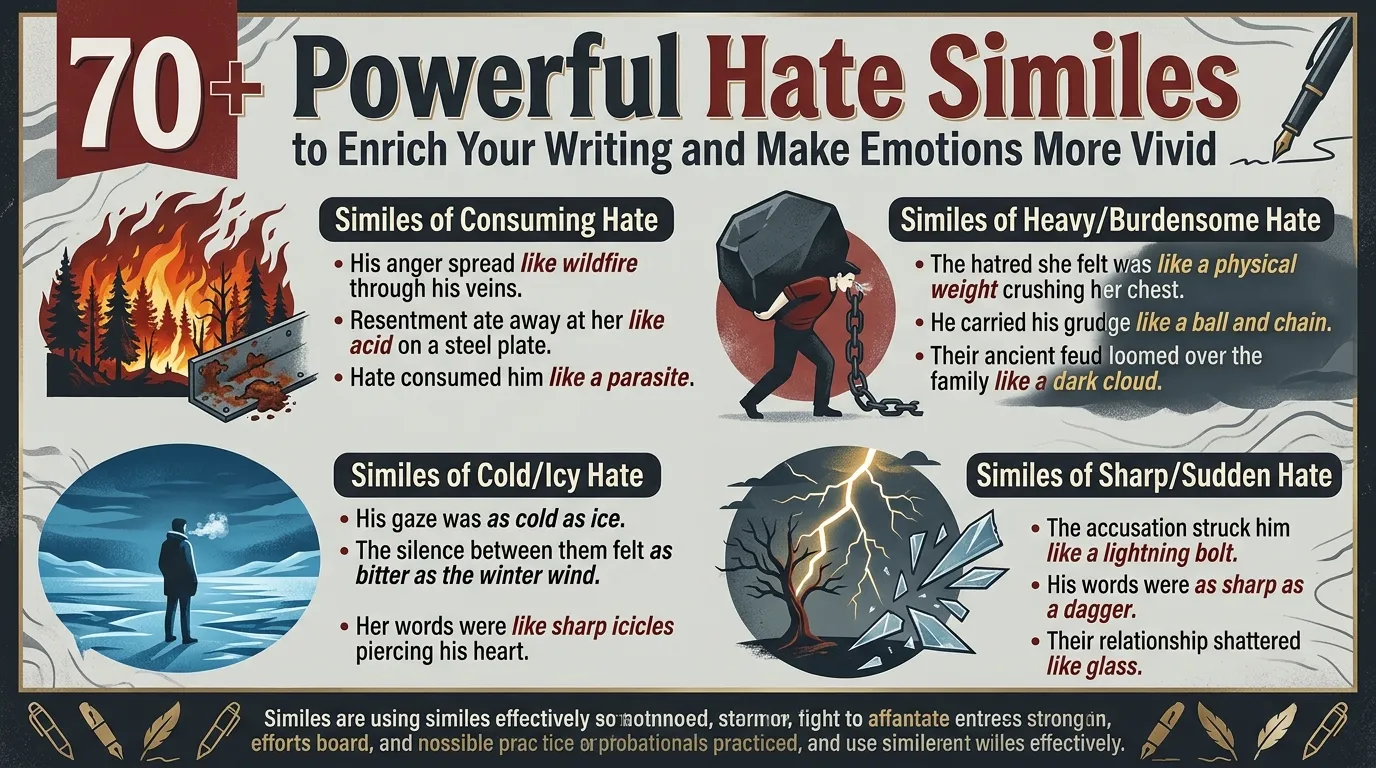
Similes are one of the easiest and most powerful tools writers use to make emotions feel real, vivid, and memorable. Instead of simply saying someone is angry, upset, or hateful, a simile compares that feeling to something familiar using words like “as” or “like.” This makes writing more emotional, visual, and engaging for readers.
When it comes to expressing strong emotions, similes for hate can add intensity, depth, and personality to your writing. Whether you are writing a story, poem, essay, speech, blog post, or even social media content, the right simile can help readers instantly understand the mood and emotional tension.
For example, saying “His hatred burned like wildfire” creates a much stronger image than simply saying “He hated him.” The comparison adds emotion, movement, and energy.
What Is a Simile?
A simile is a figure of speech that compares two different things using the words “like” or “as.”
Similes help readers imagine emotions, actions, and situations more clearly by connecting them to something familiar.
Simple Examples of Similes
- Her smile was as bright as the sun.
- He ran like the wind.
These comparisons make writing more colorful and emotional.
When using similes for hate, the goal is to describe feelings of anger, bitterness, resentment, or disgust in a vivid and relatable way.
Powerful Similes for Hate
1. Hate like wildfire
Meaning
Hatred spreading quickly and uncontrollably.
Deeper Definition
This simile describes hate that grows rapidly and affects everything around it.
Usage Insight
Best for emotional storytelling, dramatic essays, or intense conversations. Works well in both casual and literary writing.
Example Sentences
- Rumors spread through the town like wildfire fueled by hate.
- His hatred for betrayal burned like wildfire inside him.
2. Hate like poison in the veins
Meaning
Hate slowly damaging someone from within.
Deeper Definition
It compares hatred to poison that harms both the mind and emotions over time.
Usage Insight
Perfect for serious writing, emotional fiction, and reflective essays.
Example Sentences
- Jealousy moved through her heart like poison in the veins.
- Hatred sat inside him like poison he could never remove.
3. Hate like a storm cloud
Meaning
A heavy feeling of anger waiting to explode.
Deeper Definition
This simile suggests emotional tension building before conflict happens.
Usage Insight
Useful in stories, poetry, and dramatic descriptions.
Example Sentences
- His anger hung over the room like a storm cloud.
- Hate followed their conversation like a dark storm cloud.
4. Hate like burning coal
Meaning
Hatred that stays hot and painful for a long time.
Deeper Definition
The simile emphasizes lingering resentment and emotional heat.
Usage Insight
Ideal for emotional narratives and poetic writing.
Example Sentences
- Old grudges stayed in her chest like burning coal.
- His hatred glowed like burning coal beneath the surface.
5. Hate like ice in the heart
Meaning
Cold, emotionless hatred.
Deeper Definition
This simile portrays hate as distant, frozen, and lacking compassion.
Usage Insight
Best for describing cold characters or emotional detachment.
Example Sentences
- She looked at him with hate as cold as ice in the heart.
- His words carried an icy hatred through the room.
6. Hate like a chained beast
Meaning
Suppressed hatred waiting to break free.
Deeper Definition
The comparison suggests dangerous emotions being barely controlled.
Usage Insight
Excellent for suspenseful stories and psychological writing.
Example Sentences
- His anger shook inside him like a chained beast.
- Hate growled beneath her calm expression like a trapped animal.
7. Hate like acid on metal
Meaning
Hatred slowly destroying relationships or emotions.
Deeper Definition
The simile compares hate to corrosion that weakens things over time.
Usage Insight
Great for essays, relationship writing, and emotional fiction.
Example Sentences
- Resentment ate at their friendship like acid on metal.
- Hatred dissolved their trust like acid burning steel.
8. Hate like a volcano
Meaning
Explosive and uncontrollable anger.
Deeper Definition
This simile describes emotions that build pressure before violently erupting.
Usage Insight
Perfect for dramatic scenes and emotional storytelling.
Example Sentences
- His hatred erupted like a volcano during the argument.
- Years of anger exploded like molten lava.
9. Hate like thorns in the skin
Meaning
Constant emotional pain caused by hatred.
Deeper Definition
The simile highlights irritation, discomfort, and emotional suffering.
Usage Insight
Useful in poetry and reflective writing.
Example Sentences
- Bitterness stayed with her like thorns in the skin.
- His hateful memories pricked him like sharp thorns.
10. Hate like a shadow at night
Meaning
Hatred constantly following someone.
Deeper Definition
This comparison suggests emotional darkness that never fully disappears.
Usage Insight
Works beautifully in poetic and symbolic writing.
Example Sentences
- Hate followed him like a shadow at night.
- Her resentment stayed close like darkness after sunset.
11. Hate like boiling water
Meaning
Intense anger close to exploding.
Deeper Definition
This simile emphasizes emotional pressure and heat.
Usage Insight
Ideal for arguments and emotional scenes.
Example Sentences
- His temper rose like boiling water on a stove.
- Hate bubbled inside her during the meeting.
12. Hate like a knife to the soul
Meaning
Deep emotional pain mixed with hatred.
Deeper Definition
The comparison shows emotional wounds that feel personal and sharp.
Usage Insight
Best for emotional fiction and dramatic poetry.
Example Sentences
- Their betrayal cut like a knife to his soul.
- Hate stabbed at her heart during the confrontation.
13. Hate like smoke in the air
Meaning
Hatred spreading everywhere.
Deeper Definition
This simile suggests tension that affects an entire environment.
Usage Insight
Useful in storytelling and descriptive scenes.
Example Sentences
- The room filled with tension like smoke in the air.
- Hatred drifted between them during dinner.
14. Hate like rust on iron
Meaning
Slow emotional decay caused by resentment.
Deeper Definition
The simile compares hate to corrosion that weakens over time.
Usage Insight
Excellent for reflective essays and relationship themes.
Example Sentences
- Years of bitterness spread like rust on iron.
- Hate slowly weakened their bond.
15. Hate like a barking dog
Meaning
Loud and aggressive hatred.
Deeper Definition
This simile describes open hostility and constant aggression.
Usage Insight
Good for casual writing and character descriptions.
Example Sentences
- His insults came nonstop like a barking dog.
- Hate barked through every word she said.
16. Hate like a burning furnace
Meaning
Extreme emotional intensity.
Deeper Definition
The comparison highlights powerful and consuming anger.
Usage Insight
Perfect for dramatic scenes and emotional writing.
Example Sentences
- Rage burned inside him like a furnace.
- Her hatred grew hotter with every lie.
17. Hate like thunder before rain
Meaning
Hatred signaling coming conflict.
Deeper Definition
This simile suggests emotional tension before an emotional outburst.
Usage Insight
Great for suspense and storytelling.
Example Sentences
- His voice rumbled like thunder before rain.
- Hate filled the silence before the fight began.
18. Hate like chains around the mind
Meaning
Hatred trapping someone emotionally.
Deeper Definition
The simile suggests emotional imprisonment and negativity.
Usage Insight
Best for reflective and motivational writing.
Example Sentences
- Bitterness wrapped around him like chains.
- Hate kept her thoughts trapped for years.
19. Hate like a snake in the grass
Meaning
Hidden or sneaky hatred.
Deeper Definition
This simile refers to secret resentment waiting to strike.
Usage Insight
Useful for betrayal themes and character conflicts.
Example Sentences
- His jealousy waited like a snake in the grass.
- Hidden hate slithered beneath her polite smile.
20. Hate like fire in dry woods
Meaning
Hatred spreading rapidly and dangerously.
Deeper Definition
The comparison shows how quickly emotions can escalate.
Usage Insight
Excellent for social conflict and dramatic writing.
Example Sentences
- Online arguments spread like fire in dry woods.
- Hate consumed the group within days.
21. Hate like a heavy chain
Meaning
Hatred becoming emotionally exhausting.
Deeper Definition
The simile emphasizes emotional burden and stress.
Usage Insight
Works well in emotional essays and self-reflection.
Example Sentences
- Resentment weighed on him like a heavy chain.
- Carrying hate made her emotionally tired.
22. Hate like shattered glass
Meaning
Sharp, painful emotional hostility.
Deeper Definition
This simile highlights emotional damage and danger.
Usage Insight
Useful in poetry and emotional fiction.
Example Sentences
- Their conversation broke apart like shattered glass.
- Hate cut through her words sharply.
23. Hate like a roaring fire
Meaning
Powerful and uncontrollable hatred.
Deeper Definition
The simile suggests intense emotional destruction.
Usage Insight
Great for action scenes and emotional storytelling.
Example Sentences
- His anger roared like an unstoppable fire.
- Hate spread through the crowd rapidly.
24. Hate like mud on white cloth
Meaning
Hatred ruining something pure or good.
Deeper Definition
This comparison shows how negativity stains relationships and reputations.
Usage Insight
Best for moral lessons and reflective writing.
Example Sentences
- Jealousy stained their friendship like mud on white cloth.
- Hate ruined the peaceful atmosphere instantly.
25. Hate like a cage around the heart
Meaning
Hatred preventing emotional freedom.
Deeper Definition
The simile describes emotional isolation caused by resentment.
Usage Insight
Ideal for emotional essays, poetry, and self-growth content.
Example Sentences
- His bitterness became a cage around his heart.
- Hate stopped her from trusting people again.
How to Use Similes for Hate Effectively in Writing
In Essays
Use similes carefully to strengthen emotional arguments without sounding overly dramatic. Academic essays benefit from balanced and meaningful comparisons.
Example:
- Prejudice can spread through society like wildfire if left unchallenged.
In Stories
Similes help reveal emotions, create tension, and deepen character development.
Example:
- Her hatred followed him like a shadow through every hallway.
In Poetry
Poetry often uses emotional and symbolic similes to create vivid imagery and rhythm.
Example:
- Your hate burned like a lonely furnace in winter.
In Content Writing and Blogging
Bloggers can use similes to make articles more engaging and relatable for readers.
Example:
- Online negativity spreads like fire in dry woods across social media.
FAQ About Similes for Hate
What are similes for hate?
Similes for hate are comparisons that describe hatred, anger, resentment, or bitterness using “like” or “as.”
Why are similes important in writing?
Similes make writing more vivid, emotional, and easier for readers to imagine and connect with.
Can similes be used in formal writing?
Yes. When used carefully, similes can improve essays, speeches, and professional content by making ideas clearer and more memorable.
What is the difference between a simile and a metaphor?
A simile uses words like “like” or “as,” while a metaphor directly states that one thing is another.
Example:
- Simile: Hate spread like wildfire.
- Metaphor: Hate was a wildfire.
Are hate similes useful in storytelling?
Absolutely. They help writers show emotional tension, conflict, and character emotions more effectively.
How can I create my own similes?
Think about the emotion you want to describe and compare it to something familiar, visual, or emotionally powerful.
Conclusion
Using powerful similes for hate can completely transform ordinary writing into something emotional, vivid, and memorable. Instead of simply stating that someone feels angry or bitter, similes allow readers to see, feel, and experience those emotions more deeply.
Whether you are writing essays, stories, poems, blogs, or creative content, these comparisons add imagery, emotion, and personality to your words. They also help readers connect with characters, ideas, and situations in a more meaningful way.
The best similes feel natural, relatable, and emotionally clear. By experimenting with different styles and tones, you can make your writing stronger and more engaging without sounding repetitive or dull.

James Williams is a dedicated language writer and contributor at Mitaphor.com, where he explores the art of similes, metaphors, and word meanings. With a passion for making language simple and engaging, James breaks down complex expressions into clear, easy-to-understand insights. His work is designed to help students, writers, and curious readers better understand figurative language and use it effectively in everyday communication.